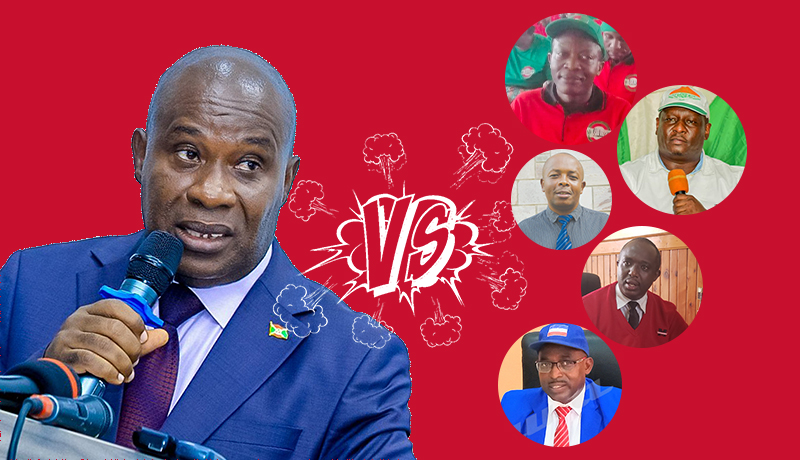
Five Burundian opposition political parties have rejected ongoing preparations for the 2027 presidential election, demanding inclusive political dialogue ahead of any further steps. In a joint statement published on May 8, 2026, the parties denounced the National Independent Electoral Commission (CENI), stating it is unbalanced and incapable of guaranteeing transparent, credible, and peaceful elections. The opposition groups announced their intention to use "all political, legal, and democratic means" to demand a credible recomposition of the electoral institution.
The statement's publication coincided with a meeting organized by the CENI in Bujumbura for electoral partners, which included political parties, civil society organizations, and religious denominations. The five signatory parties to the joint statement are Uprona, Sahwanya-Frodebu, Codebu, CDP, and CNL. Their collective stance shows growing concerns among opposition factions regarding the electoral framework as the next presidential polls approach.
Concerns Over 2025 Elections
Opposition parties have expressed deep reservations concerning the organization and outcomes of the 2025 legislative and municipal elections in Burundi. Following the proclamation of the 2025 legislative election results, these political parties denounced several irregularities that they stated marred the vote. These irregularities included the violent exclusion of party representatives from multiple polling stations, intimidation of voters and assessors, alleged cases of multiple voting, and illegal arrests of political representatives.
The opposition parties also denounced opaque vote counting, claiming that votes obtained by other formations were attributed to the ruling CNDD-FDD. Appeals were filed at the time with competent institutions, including the President of the Republic and the Constitutional Court, seeking redress for these issues. Keffa Nibizi stated that the current National Independent Electoral Commission (CENI) experienced problems in 2025, raising fears for the upcoming presidential election.
Olivier Nkurunziza further elaborated that the 2025 elections were marked by serious irregularities, specifying voter intimidation, ballot stuffing, voting before official hours, a lack of neutrality among some polling station members, and the illegal presence and intimidation by youth affiliated with the ruling party. The article notes the CNDD-FDD party's significant control over the state apparatus, which opposition groups suggest contributes to these issues.
In response, the President of the Republic, already designated as the CNDD-FDD candidate for his own succession, stated on social media platform X that he had received the message from the five political parties. He promised to meet them for a dialogue focused on appeasement and national unity.
Demands for Dialogue and Reform
During the meeting, Gabriel Banzawitonde, president of the Alliance of Patriots for the Restoration of the Republic (APDR), and Aloys Baricako, president of the National Rally for Change (Ranac), departed after denouncing what they described as a "disbalanced process." The five signatory parties indicated their intention to favor a distinct consultation framework to call for sincere dialogue before any continuation of the electoral calendar. The parties are calling for "institutional and legal reforms capable of restoring the confidence of citizens and political actors in the Burundian electoral system." They also requested the Head of State to facilitate the opening of "an inclusive political dialogue to examine the denounced irregularities and ensure adequate treatment of the appeals filed." The correspondence addressed to the President was transmitted on April 4, 2026.
Olivier Nkurunziza, president of Uprona, explained that non-participation in CENI meetings is a matter of responsibility due to serious irregularities observed in the 2025 elections, not a boycott. "The lack of an appropriate response to these appeals leaves serious concerns about the credibility of electoral institutions," Nkurunziza stated. He added, "The 2025 elections were marked by several serious irregularities: intimidation of voters, ballot stuffing, voting before the official time, lack of neutrality of some polling station members, as well as the illegal presence and intimidation carried out by youth affiliated with the ruling party around and sometimes inside polling centers." Nkurunziza believes that participating in electoral preparations without reform would mean endorsing a system that guarantees neither transparency nor equity. "This is why we demand sincere dialogue to discuss all these issues," he affirmed.
Patrick Nkurunziza stated that opposition groups refuse to be mere participants in a pre-determined process, arguing that a contested CENI cannot serenely organize such an important presidential election. He indicated that if opposition demands are not met, they will refuse to participate in what he calls an "electoral staging" lacking minimal transparency guarantees. Olivier Nkurunziza stated that the strength of his party and the opposition lies in the legitimacy of their demands, noting that other political formations, civil society organizations, and citizens share the same concerns. "We believe in political dialogue, legal mechanisms, and peaceful democratic pressure to obtain a truly independent, balanced, and credible CENI," Nkurunziza said. He concluded by asserting, "The Burundian opposition has ideas, competent cadres, an alternative political project capable of responding to citizens' concerns, which include, among others, the high cost of living, unemployment, social justice, governance, and public freedoms."
Opposition's Broader Grievances
Keffa Nibizi, president of Codebu, stated that Burundi has experienced a decline across various sectors, including democracy, human rights, politics, economy, and society. Nibizi added that the Burundian population is fatigued, having hoped for economic recovery and respect for human rights after the resumption of elections in 1993, but instead witnessed a regression. "La population burundaise est fatiguée," Nibizi said, further explaining, "Malheureusement, nous avons connu plutôt un recul. Si on regarde le pouvoir d’achat de la population, il n’a fait que dégringoler." He noted that the purchasing power of citizens has consistently declined, marked by shortages of essential products such as fuel and medicines, increasingly expensive food items, insufficient salaries for civil servants, and unbearable rents.
Nibizi believes that in a presidential system, change requires not just a new individual but a systemic overhaul of the ruling party and the presidency. He elaborated, "dans un système politique dominé par le régime présidentiel, on ne peut pas penser à un changement si on ne change pas le parti qui dirige le pays, donc le parti qui a le président de la République. En effet, il ne s’agit pas de changer la personne. Il s’agit de changer tout un système car, à y voir de près, le vrai défi n’émane pas des personnes placées, mais du fonctionnement du système en soi." Olivier Nkurunziza also affirmed that the opposition possesses ideas, competent cadres, and an alternative political project designed to address citizen concerns, including the high cost of living, unemployment, social justice, governance, and public liberties.
Patrick Nkurunziza, president of Sahwanya-Frodebu, cautioned that the stakes of the 2027 election extend beyond a simple political alternation, questioning whether Burundi will hold a genuine election or merely perpetuate a predetermined system. He warned that without serious reforms, the country risks facing an institutional legitimacy crisis. Despite these concerns, Patrick Nkurunziza asserted that "Si les règles du jeu sont transparentes et équitables, le peuple burundais peut créer la surprise."
Expert and Civil Society Views
During the 2025 legislative elections, the Alliance of Patriots for the Restoration of the Republic (APDR) secured ninth position, while the National Rally for Change (Ranac) finished eleventh. Gabriel Rufyiri, president of Olucome, stated that the commission preparing the elections does not appear independent, asserting that the parties refusing to participate in preparatory meetings are justified. Rufyiri observed that the Burundian political opposition possesses diminishing strength to demand concessions from those in power. He also noted a general fear among Burundians, declaring, "There is a problem of expression in this country." He added, "The press is not free, despite what public authorities say. So, freedom of expression remains lacking in Burundi." Rufyiri emphasized, "Fear gnaws at many Burundians." He stated the 115 billion Burundian francs budget for the next election was less concerning than its management. "We need free, transparent, inclusive, and peaceful elections. Once these four factors are not met, you understand that it is a big problem," Rufyiri said. Jurist and university professor Alexis Manirakiza believes the opposition's demands have slim to no chance of being met, noting, "The paternalistic tone adopted to respond to their concerns is hardly encouraging."