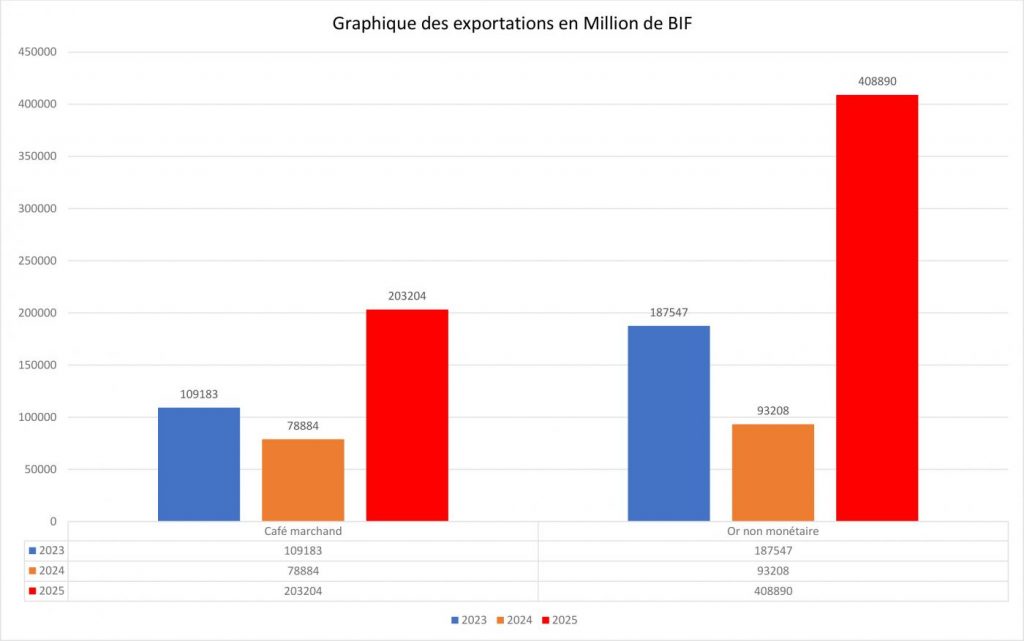
Burundi's export revenues are projected to experience a significant increase in 2025, with a "spectacular progression of 95%" compared to 2024. This surge is anticipated to be driven primarily by strong performance in the nation's coffee and gold sectors, underpinning a substantial boost to the country's economic outlook. The Central Bank of Burundi (BRB) has noted this growth as a key indicator of economic recovery and diversification efforts. Overall, Burundi's exports recorded this remarkable progression, rising from 506,089.5 million BIF in 2024 to a projected 985,812 million BIF in 2025. This nearly doubling of export earnings is expected to have a profound impact on the nation's financial stability and its capacity for development.
Key Export Drivers Detailed
Merchant coffee exports are projected to see a substantial increase, rising from 78,884 million BIF in 2024 to 230,204 million BIF in 2025. This significant growth, representing a more than threefold increase, notes coffee's enduring role as a primary agricultural commodity contributing to the nation's export revenue. The mining sector also demonstrates significant expansion, with non-monetary gold exports expected to climb dramatically from 93,208 million BIF in 2024 to 408,891 million BIF in 2025. This represents an even more pronounced increase, showcasing the growing importance of mineral resources in Burundi's export portfolio. The Central Bank of Burundi (BRB) data indicates that the combined performance of these two sectors is a major contributor to the overall export surge, providing key foreign exchange earnings.
This enhanced export performance is set to positively impact Burundi's trade balance. The import coverage rate is forecast to improve significantly from 16.3% in 2024 to 27.8% in 2025, reflecting the country's increased capacity to finance its imports through export earnings. This improvement signifies a stronger external position for the Burundian economy, reducing its vulnerability to external shocks and potentially strengthening the national currency. The Central Bank of Burundi (BRB) provided these full data points, emphasizing the positive trajectory.
Concerns Over Raw Material Exports
The data underpinning these export and import projections comes directly from the Central Bank of Burundi (BRB). While the surge in export revenues, particularly from coffee and gold, signals a positive economic trajectory, the reliance on raw material exports often raises questions about long-term economic diversification and value addition. Economies heavily dependent on primary commodities can be vulnerable to global price fluctuations and supply chain disruptions, which can lead to volatility in national income. Experts frequently suggest that processing raw materials domestically before export can create more jobs, generate higher revenues, and foster industrial development within the country. This strategy enhances local economic activity and builds a more resilient economy.
Burundi's current export strategy, as indicated by the BRB's figures, shows a significant emphasis on unprocessed or minimally processed goods. This approach, while currently boosting revenues, could prompt discussions regarding future policies aimed at enhancing local manufacturing and diversifying the export base to include more finished or semi-finished products. Such diversification could provide more stable and higher-value export streams in the long run.
Economic Implications and Broader Issues
Burundi's export revenues are projected to increase significantly, from 506,089.5 million BIF in 2024 to 985,812 million BIF in 2025, according to Central Bank of Burundi (BRB) data. Concurrently, the country's imports are also expected to rise, increasing from 3,099.9 billion BIF in 2024 to 3,538 billion BIF in 2025. This represents an increase of 438 billion BIF, or 14 percent, over the year. While exports are growing faster than imports in percentage terms, the absolute value of imports remains substantially higher. The overall economic context in Burundi includes broader societal issues that continue to draw international attention. For example, the disappearance of journalist Jean Bigirimana occurred 3587 days prior to the current reporting period, a somber reminder of ongoing human rights concerns.