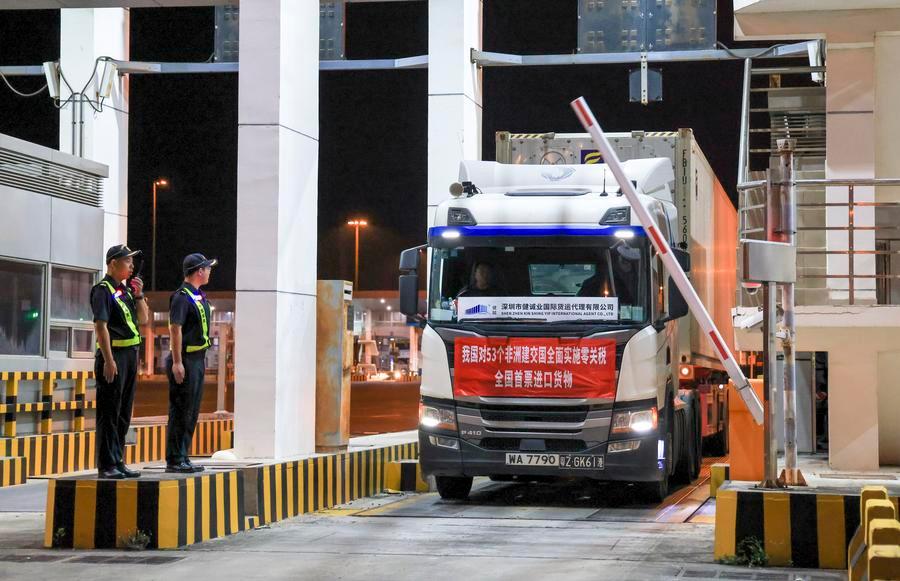
China implemented a historic zero-tariff policy for goods from 53 African nations on Friday, May 1, 2026, granting them duty-free access to its vast market. The new trade measure aims to deepen economic ties between China and the African continent, fostering closer economic cooperation and promoting common development between the two regions. On the policy's effective date, Friday, May 1, 2026, a significant milestone was reached as a shipment of 24 metric tons of South African apples successfully cleared customs in Shenzhen, marking the first entry under the expanded tariff-free scheme. This initial transaction showed the immediate impact and practical application of China's broadened trade initiative.
This latest initiative follows an earlier phase where China had already removed tariffs on 100% of tariff lines for 33 poorer African countries, specifically least developed countries (LDCs), a policy that took effect on December 1, 2024. That earlier move set the precedent for increased trade facilitation and demonstrated China's long-term commitment to fostering economic partnerships across the African continent. According to China's General Administration of Customs, Sino-African trade reached a record $348 billion USD in 2025, showing the growing economic relationship and the increasing volume of goods exchanged between China and African nations. Reports indicated that China stands as Africa's largest trade partner, a position solidified by years of strategic investment and trade policies. This new zero-tariff policy is poised to further enhance this already strong economic partnership, potentially leading to even higher trade volumes in the coming years.
Expanding Trade Access
The new zero-tariff policy is expected to significantly benefit more prosperous African nations, including key economies such as Kenya, Egypt, and Nigeria. These countries, while not classified as Least Developed Countries, will now gain improved access to the Chinese market, opening new avenues for their exports. Under the new agreement, 20 African countries not classified as LDCs will receive preferential customs tariffs for two years, specifically enjoying zero tariffs on their goods entering China. This targeted approach acknowledges the diverse economic landscapes within Africa and aims to provide a broader range of nations with competitive advantages in the Chinese market. Historically, African products such as cocoa from Côte d'Ivoire and Ghana, coffee and avocados from Kenya, and citrus and wine from South Africa faced tariffs ranging from 8% to 30% when entering the Chinese market. The removal of these duties is anticipated to make African goods more competitive and attractive to Chinese consumers, potentially boosting export volumes and revenues for African producers.
The impact of these tariffs was substantial, often adding significant costs to African exports and limiting their market penetration in China. For instance, the previously imposed tariffs meant that products like South African wine, Kenyan coffee, or Ghanaian cocoa had to absorb these additional costs, making them less price-competitive compared to goods from other regions with more favorable trade agreements. With the elimination of these tariffs, African producers can now offer their products at more competitive prices, or retain a larger share of the profit, which could stimulate further investment in their respective industries. Reports indicate that Ivory Coast and Ghana together supply over 50% of the global cocoa market, making them key players in the agricultural sector. The zero-tariff policy for their cocoa exports to China could significantly expand their market share in one of the world's largest consumer markets, providing a substantial economic uplift. Similarly, South Africa, a significant exporter of citrus fruits, including oranges, grapefruits, and lemons, stands to gain considerably from the expanded access to the Chinese market, where demand for fresh produce is consistently high.
In 2025, China's exports to Africa reached $225 billion, marking an approximate 25% increase from the previous year, while its imports from Africa totaled $123 billion, an approximate 5% rise. This trade pattern resulted in a widening trade deficit for Africa, a trend that the new zero-tariff policy aims to help rebalance by stimulating African exports. Of the $348 billion USD in total Sino-African trade in 2025, Chinese imports from Africa constituted $123 billion USD, representing a 5.4% increase from the previous year. While this growth in imports is positive, the disparity in export and import growth rates notes the need for policies that specifically bolster African outbound trade. The Customs Tariff Commission of China stated that the agreement aims to promote common development between China and Africa, fostering closer economic cooperation and working towards a more balanced trade relationship.
Geopolitical and Economic Context
China's 15th Five-Year Plan, covering the period from 2026 to 2030, sets out the nation's commitment to expanding openness and cultivating a transparent, stable, and predictable institutional environment. This overarching strategic framework provides the context for the new zero-tariff policy, aligning it with China's broader goals for international trade and economic engagement. The policy shift occurs at a time when African nations have actively sought new markets, particularly after the United States imposed reciprocal tariffs a year prior to China's latest trade announcement. This search for diversified trade partners shows Africa's strategic imperative to reduce reliance on any single market and to secure more favorable trade terms globally.
The imposition of U.S. Tariffs had a notable impact on African economies. At one point, U.S. Tariffs on South Africa had reached 30%, with some other African countries facing duties exceeding 40%. These high tariffs significantly impacted the competitiveness of African goods in the American market, prompting a re-evaluation of trade strategies by African governments and businesses. The U.S. Supreme Court subsequently ruled former President Donald Trump's global tariffs unconstitutional in February, a decision that could potentially alter future U.S. Trade policy. However, the immediate impact of past tariffs spurred African nations to explore alternatives, making China's zero-tariff offer particularly timely and attractive.
Africa's population is projected to reach 2.5 billion by 2050, representing a significant and growing market with immense potential for both consumption and production. This demographic trend makes the continent an increasingly important economic partner on the global stage. Amid these demographic and trade shifts, Thierry Pairault, an expert at France's National Center for Scientific Research, offered insights into the policy's implications. Pairault observed that most African raw material exports, including oil and minerals, already enjoyed tariff-free access to China, suggesting that the new policy primarily targets processed goods and agricultural products. This focus on non-raw material exports could help African nations diversify their economies and move up the value chain.
Pairault also suggested that Chinese President Xi Jinping is positioning China as the antithesis to Western protectionism through such policies. In a global trade environment often characterized by rising protectionist sentiments and trade disputes, China's move to open its market to African goods without tariffs can be seen as a strategic diplomatic and economic statement. However, Pairault noted in an assessment published by the China Global South Project that the policy "only applies where it costs (China) almost nothing." This critical perspective suggests that while the policy is beneficial for African nations, China may have carefully selected product categories where the impact on its domestic industries is minimal, or where it can secure essential resources or political goodwill at a low economic cost. This nuanced view notes the complex interplay of economic and geopolitical motivations behind such large-scale trade initiatives.
African and Expert Reactions
The new zero-tariff policy encompasses 20 of Africa's largest economies, including South Africa, Egypt, Nigeria, Algeria, and Kenya. This broad inclusion ensures that a significant portion of Africa's economic output and population stands to benefit directly from the enhanced market access. This expansion means that 53 of Africa's 54 nations are now eligible for tariff-free treatment on their goods entering China, representing an almost continent-wide embrace of the policy. The only African nation not included in the policy is Eswatini, a decision attributed to its diplomatic ties with Taiwan. This exclusion shows the geopolitical considerations that often intertwine with trade agreements, with China maintaining its "One China" policy in its international relations.
For the included nations, the implications are substantial. South Africa, for instance, is not only a significant exporter of citrus fruits but also has a diverse economy that could leverage this policy to expand exports of manufactured goods and other agricultural products. The removal of tariffs on wine from South Africa, for example, could open up new opportunities in the rapidly growing Chinese consumer market for alcoholic beverages. Egypt, with its burgeoning industrial sector, and Nigeria, with its vast agricultural potential, could also see significant boosts to their export economies. Similarly, Algeria and Kenya, with their respective strengths in energy and agriculture, are well-positioned to capitalize on the new trade terms.
China's Customs Tariff Commission stated that the agreement aims to promote common development between China and Africa, fostering closer economic cooperation. This official statement reiterates China's long-standing narrative of South-South cooperation and mutual benefit. The policy is presented as a mechanism to help African countries achieve economic growth and industrialization by providing a stable and predictable market for their products. This aligns with broader Chinese foreign policy objectives to strengthen ties with developing nations and to present itself as a champion of multilateralism and open trade. The zero-tariff policy, therefore, is not merely an economic measure but also a significant diplomatic gesture, reinforcing China's commitment to its African partners and further integrating the continent into its global trade network.