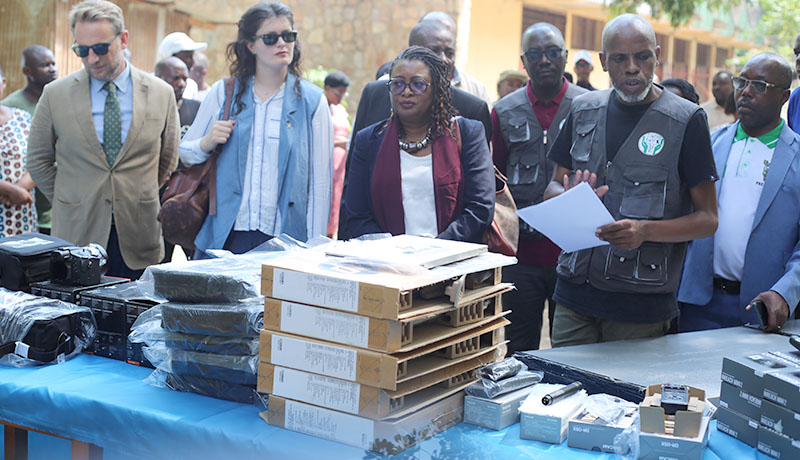
New equipment was delivered to the Office Burundais pour la Protection de l'Environnement (OBPE) for the Rusizi and Kibira national parks by several international partners. The Programme des Nations-unies pour le développement (Pnud), the Union européenne au Burundi (UE), and the Ambassade du Royaume de Belgique au Burundi acted as donors for the initiative. This significant contribution shows the commitment of these international partners to environmental stewardship in the region. This donation is part of the "Dukingire Ibidukikije" (Protect our environment) program, a full initiative aimed at safeguarding Burundi's natural heritage. The equipment aims to strengthen the operational capacities of the OBPE in the sustainable management of both the Kibira and Rusizi national parks, enhancing their ability to protect these vital ecosystems. The contribution supports the broader objectives of achieving Vision Burundi 2040-2060, aligning environmental protection with national development goals and charting a course for sustainable growth. The program's overarching objective is to improve the effectiveness of the protected areas management system for biodiversity conservation in Burundi, ensuring the long-term health and resilience of its natural environments.
Details of the Environmental Support
The equipment supplied to the Office Burundais pour la Protection de l'Environnement (OBPE) encompasses a range of items designed to enhance both field operations and analytical capabilities, providing a strong toolkit for park management. This includes solar photovoltaic systems, which will provide renewable energy for various park facilities, promoting energy independence and reducing the carbon footprint of conservation efforts. Alongside these, full laboratory equipment specifically for water analysis was provided, enabling detailed monitoring of water quality within and around the protected areas, which is key for ecosystem health. Additionally, the donation features computer equipment and essential office and field furniture, supporting administrative functions and on-site operational needs, from data management to staff comfort in remote locations.
Among the specialized tools provided are camera traps, key for wildlife monitoring and research within the national parks, allowing for non-invasive tracking of animal populations and behavior. GPS devices were also included to aid in mapping, navigation, and data collection by park personnel, improving precision in conservation activities and patrol routes. The European Union's involvement in this initiative marks a significant milestone, representing the first financing of its scale from the institution directed towards Burundi's environment sector, signaling a new level of engagement and support. This substantial investment notes the EU's recognition of the critical importance of environmental conservation in Burundi.
The overarching "Dukingire Ibidukikije" program, under which this equipment is provided, has multiple objectives, reflecting a holistic approach to environmental management. It aims to preserve Burundi's natural resources, from its diverse flora and fauna to its water bodies and landscapes. Simultaneously, the program seeks to support environment-related economic activities within the country, fostering sustainable livelihoods that are compatible with conservation goals. The program is designed to contribute directly to the National Development Plan 2018-2027, aligning environmental protection efforts with broader national development goals and strategies, thereby integrating ecological concerns into the nation's socio-economic fabric.
Context and Strategic Alignment
The initiative builds upon previous achievements, which include the demarcation of both Kibira and Rusizi national parks, a foundational step in defining and protecting these critical areas. Equipment has also been provided to eco-guards, empowering these frontline conservationists with the tools they need to perform their duties effectively. An exhibition on Rusizi park was organized, raising public awareness and appreciation for its unique biodiversity, and the offices for Rusizi park have been inaugurated, providing a dedicated administrative and operational base. These cumulative efforts contribute to the broader conservation strategy, creating a stronger framework for protected area management.
The government of Burundi has designated the conservation of protected areas as a major priority within its Vision 2040-2060. This long-term national development framework emphasizes environmental stewardship as a core component of future growth, recognizing that ecological health is fundamental to sustainable prosperity. The Burundian government has made the conservation of protected areas a major priority of Vision 2040-2060, demonstrating a long-term commitment to safeguarding its natural heritage. This strategic alignment ensures that environmental protection is not an isolated effort but an integral part of the nation's long-term development trajectory.
Preserving biodiversity, according to the initiative's framework, necessitates joint involvement from multiple stakeholders. These include the government, technical and financial partners, the private sector, local communities, and the media. This collaborative approach is integral to achieving sustainable conservation outcomes in Burundi's national parks, recognizing that shared responsibility leads to more effective and lasting solutions. This multi-stakeholder engagement is seen as essential for fostering a collective sense of ownership and responsibility towards Burundi's natural resources.
Vision for Biodiversity and Development
The recent delivery of equipment occurred on May 21, 2026, marking a tangible step forward in Burundi's conservation efforts. This donation, valued at over 549 million Burundian francs, represents a significant financial commitment towards enhancing the protected areas management system in Burundi for biodiversity conservation. The program's objectives align with broader international development frameworks. Specifically, the initiative supports Sustainable Development Goal (SDG) 15, which focuses on life on land, aiming to protect, restore, and promote sustainable use of terrestrial ecosystems, sustainably manage forests, combat desertification, and halt and reverse land degradation and halt biodiversity loss. It also supports SDG 13, which addresses climate action, by contributing to ecosystem resilience and carbon sequestration through effective park management. The Belgian Embassy emphasized that biodiversity conservation holds potential as a significant driver for both development and wealth creation within the country, noting the economic benefits that can arise from healthy ecosystems. This perspective shows the dual benefit of environmental protection for ecological health and economic advancement, positioning conservation as an investment in Burundi's future prosperity. The Ambassade du Royaume de Belgique au Burundi further elaborated on this, stating that the careful management of natural resources can unlock new opportunities for eco-tourism, sustainable agriculture, and other green industries, creating jobs and improving livelihoods for local communities. This holistic view reinforces the idea that environmental protection is not merely an expense but a strategic asset for national development.