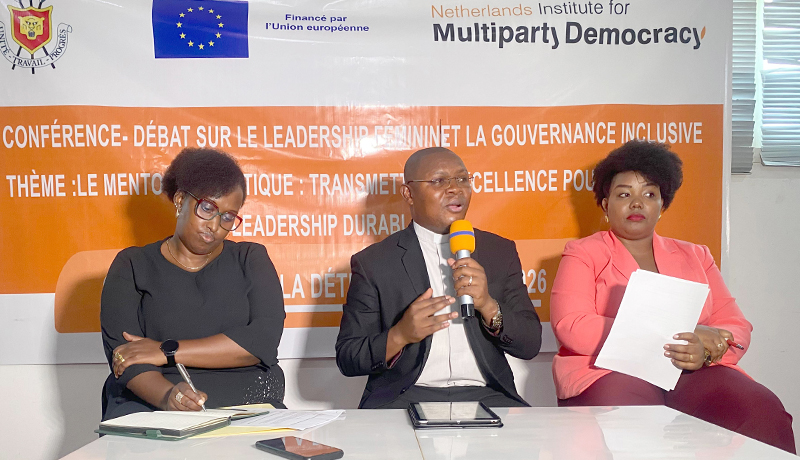
On Friday, June 5, 2026, the Netherlands Institute for Multiparty Democracy (NIMD), in partnership with the Burundian Ministry of Interior, Community Development and Public Security, organized a major conference-debate in Burundi. The event focused on women's political leadership and inclusive governance, bringing together stakeholders to discuss strategies for enhancing female participation in political life. The gathering served as a key platform for dialogue, emphasizing the importance of structured support systems to empower women in the political arena.
The conference, held in Burundi, noted political mentorship as a strategic lever for advancing women in leadership roles. This approach aims to transmit essential skills, experiences, and networks necessary for women to access positions of responsibility within the political sphere. Participants explored how structured mentorship programs could support aspiring female leaders, fostering their development and empowering them to navigate political structures effectively. The emphasis was placed on practical guidance and the sharing of insights from seasoned political figures to equip emerging women leaders with the tools they need to succeed in complex political environments. Political mentorship is presented as a strategic lever to transmit the skills, experiences, and networks essential for women's access to positions of responsibility. This strategic approach is seen as vital for bridging the gap between aspiration and achievement for women in politics.
Project Aims and Context
The Netherlands Institute for Multiparty Democracy (NIMD) has been piloting a project titled 'Support for the Strengthening of Burundian Political Parties and Civil Society as Guardians of Women's and Youth Participation and Representation in Political Life, ARPOG,' since October 2024. This initiative operates within Burundi to foster greater inclusion in the political sphere. The project's long-term vision is to create a more equitable and representative political landscape in Burundi.
The ARPOG project receives its financing from the European Union and is implemented through a partnership with the Association of Women Repatriates of Burundi (Afrabu). This collaboration aims to leverage combined expertise for its objectives. The partnership shows a commitment to sustained efforts in promoting gender equality and youth engagement in political processes. The project specifically seeks to broaden the political space for women and youth by strengthening the capacities of political parties and civil society organizations. This capacity building is designed to enhance their ability to advocate for and integrate women and youth into political processes. The initiative recognizes that strong, well-supported organizations are critical for driving meaningful change and ensuring that the voices of women and youth are heard and acted upon in policy-making. Despite these efforts, structural obstacles to women's political advancement remain tenacious within the country. Addressing these persistent barriers is a core focus of the ARPOG project's long-term strategy, acknowledging that systemic issues require full and sustained interventions.
Mentorship Strategies for Advancement
Building education that treats girls and boys equally is considered essential for preparing future leaders. This foundational principle ensures that young women are equipped from an early age with the knowledge and confidence to pursue leadership roles. Advocates suggest structured mentorship, based on the accompaniment of young women by experienced leaders, and progressive integration into decision-making spaces to gain legitimacy and expertise. This approach aims to provide practical guidance and opportunities for growth within political structures, allowing mentees to learn directly from the experiences of their mentors. Such structured programs are designed to demystify the political process and offer clear pathways for advancement.
Trans-partisan mentorship is viewed as an essential lever to transform women's digital presence into impactful, sustainable leadership. This strategy emphasizes collaboration across political divides to amplify women's influence. By working together, women from different political affiliations can present a united front on issues of common concern, thereby increasing their collective impact. Experts recommend building solid alliances between women's leagues of political parties and civil society organizations to transcend inter-party rivalries and foster a unified front for women's political advancement. These alliances can create a powerful network capable of advocating for policy changes and supporting female candidates across the political spectrum. This approach recognizes that political progress for women often requires moving beyond partisan interests.
Mentorship and intergenerational exchanges are described as essential tools for preparing young girls for responsibilities and strengthening women's leadership. These mechanisms aim to transfer knowledge and experience from seasoned leaders to the next generation, ensuring continuity and growth in women's political participation. Such exchanges are seen as key for developing a strong pipeline of female leaders capable of navigating complex political environments. By fostering these relationships, the conference noted the importance of creating a legacy of strong female leadership that can inspire and guide future generations. The exchange of wisdom between generations is considered invaluable for sustaining the momentum of women's political empowerment.
Expert and Ministry Perspectives
The conference-debate, which took place in Burundi, was themed "Political Mentorship: Transmitting Excellence for Sustainable Leadership". This theme showed the event’s central message about the enduring value of mentorship in cultivating effective political leaders. During the event, participants noted the critical importance of perseverance, commitment, and mentorship as facilitators for women to attain positions of responsibility within the political sphere. This emphasis showed the belief that these attributes and support systems are essential for overcoming barriers to women's political advancement. The discussions reinforced the idea that while talent is important, sustained effort and guidance are equally key for success. Participants emphasized the importance of perseverance, commitment, and mentorship to facilitate women's access to positions of responsibility. These qualities, combined with strategic support, are seen as key ingredients for breaking through political glass ceilings.
Currently, women hold more than 46% of the seats in the Burundian Senate and nearly 39% in the National Assembly. These figures reflect significant progress in female representation within Burundi’s legislative bodies. Despite these figures, young women entering politics face a dual challenge. They must navigate societal resistance stemming from existing inequalities while simultaneously striving to advance within political parties where leadership positions are predominantly held by men. This situation indicates that even with significant representation, structural hurdles persist for women aspiring to higher political office. Young women engaged in politics face a double challenge: breaking the resistance of an unequal society and climbing the ranks within political parties whose leadership circles remain largely male. This complex reality shows the ongoing need for targeted interventions like political mentorship to support and empower the next generation of female leaders in Burundi. The conference concluded with a call for continued dedication to these mentorship initiatives, recognizing their potential to create a more inclusive and equitable political future for Burundi.