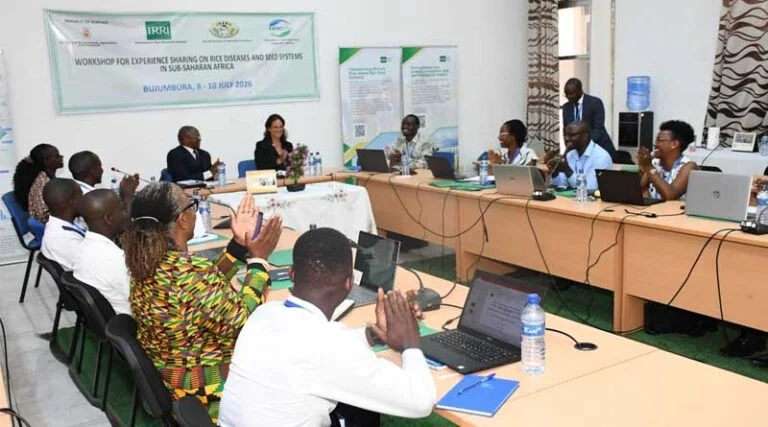
The International Rice Research Institute (IRRI) and the Korea-Africa Food and Agriculture Science Initiative (KAFACI) jointly convened a significant regional workshop in Bujumbura, Burundi. This collaborative event brought together key stakeholders from across the agricultural sector to address pressing issues. The three-day event, held in the Burundian capital, specifically sought to address critical crop disease and seed quality challenges impacting African agriculture, aiming to foster sustainable solutions for enhanced rice production in the region. Participants included a diverse group of experts and decision-makers, comprising scientists, public agricultural leaders, and private sector representatives from both Burundi and Malawi. Their collective involvement showed the multi-faceted approach required to tackle complex agricultural hurdles. The workshop provided a key platform to highlight key milestones achieved through the ongoing IRRI-KAFACI project, showcasing the progress made in its mission to bolster food security.
Disease and Seed System Innovations
A significant outcome of the workshop's discussions was the identification of six distinct rice diseases currently threatening Burundian fields. This detailed understanding of the prevalent pathogens is a critical first step in developing effective mitigation strategies. To combat these identified threats and improve resilience, diverse rice varieties sourced from IRRI's extensive germplasm collection, local Burundian breeding programs, and South Korea underwent rigorous evaluation. This evaluation focused on their yield potential and, crucially, their resistance to critical diseases, including the highly destructive Rice Yellow Mottle Virus (RYMV). The full assessment of these varieties aims to introduce more strong and productive rice options for farmers.
In Malawi, the project has focused on mapping the local seed ecosystem, a foundational step for improving seed access and quality. This initiative aimed to accelerate the production of high-quality early-generation and certified seeds, directly addressing a key challenge in the region's agricultural development: the availability of superior planting material. The full approach adopted by the IRRI-KAFACI project seeks to improve overall rice productivity by tackling both disease resistance through variety evaluation and seed system inefficiencies through strategic mapping and production acceleration. These efforts are designed to ensure that farmers have access to both disease-resistant varieties and the high-quality seeds needed for optimal yields.
On-the-Ground Collaboration and Insights
A key component of the workshop was the emphasis on practical, on-the-ground engagement. Participants in the workshop visited ITRASAGRI, a private seed company located in Burundi, to observe its operations firsthand. This visit provided valuable insights into the private sector's role in seed production and distribution within the local context. Engaging with such entities is key for understanding the entire value chain of agricultural inputs.
Further illustrating the importance of private sector involvement, Malawi’s Milele Agroprocessing shared its experience in collaborating with local farmers to produce premium rice seeds. This presentation offered practical insights into successful private sector engagement models that can be replicated and scaled across the region. Such partnerships are vital for ensuring the sustainability and commercial viability of improved agricultural practices.
Looking ahead, future steps for the project are clearly defined. These include finalizing the biological profiling of rice pathogens in Burundi, a critical step for precision disease management. The project also plans to extend disease studies to Malawi, broadening the geographical scope of its research and impact. Seasonal field trials are also planned to test the performance of new varieties and management practices under real-world conditions. Additionally, fundraising efforts will be launched to support these vital initiatives, according to project organizers, ensuring the continued momentum and expansion of the project's activities.
Expert Perspectives on Regional Impact
The collaborative efforts between the International Rice Research Institute (IRRI) and the Korea-Africa Food and Agriculture Science Initiative (KAFACI) are designed to yield significant benefits across Sub-Saharan Africa. The ongoing project, which has seen activities in Burundi and Malawi, aims to strengthen regional agricultural resilience by addressing fundamental challenges. By focusing on critical areas such as disease resistance and seed system improvements, the initiatives are poised to enhance food security and improve livelihoods for countless farmers. Workshops in locations like Bujumbura facilitate direct engagement among scientists, public agricultural leaders, and private sector representatives from participating countries, including South Korea, fostering a rich exchange of knowledge and expertise. This multi-stakeholder approach is intended to foster localized solutions and ensure the sustainable adoption of improved rice varieties and farming practices, tailored to the specific needs of each region. The involvement of private entities like ITRASAGRI and Milele Agroprocessing further shows the intent to integrate commercial viability into the agricultural development strategy, ultimately impacting farmers and economies across the region by creating sustainable pathways to prosperity.