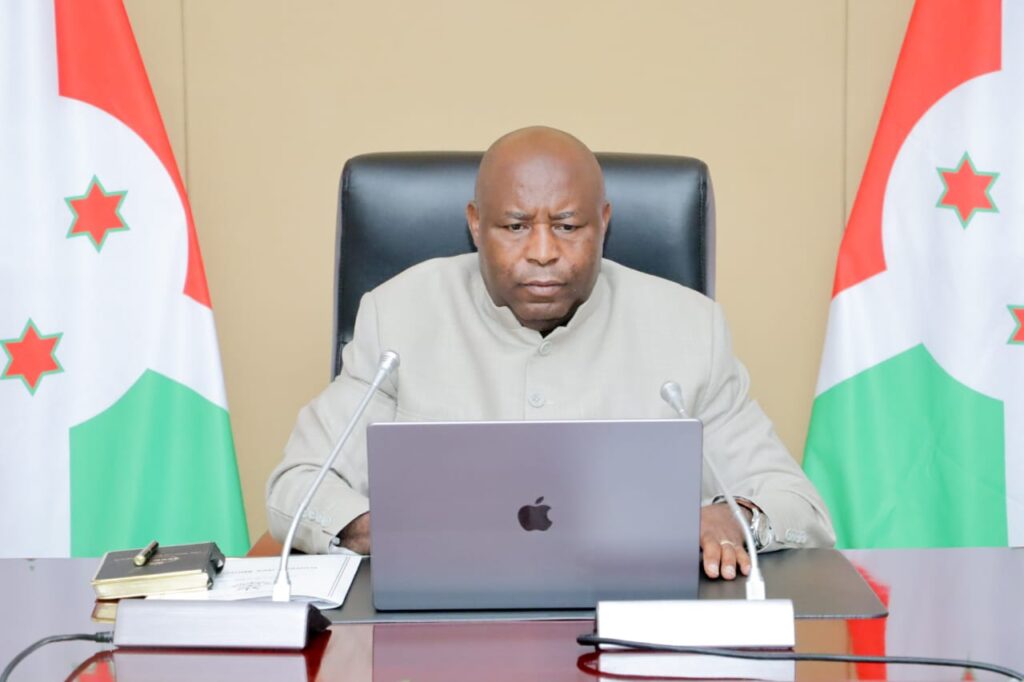
Burundi's Council of Ministers convened on Wednesday, June 10, 2026, at the Ntare Rushatsi presidential palace. The meeting was chaired by Evariste Ndayishimiye, President of Burundi and current President of the African Union. The agenda included fifteen points for discussion and approval by the council members present, reflecting a broad scope of governmental priorities.
Education and Public Information Reforms
Evelyne Butoyi, Minister of Communication and Media, presented the draft law on public information access to the Council of Ministers. This proposed legislation aims to establish full frameworks for how the public can obtain information from governmental bodies and other relevant institutions, thereby enhancing transparency and public engagement. The draft law seeks to clarify the rights of citizens regarding access to information and the obligations of information holders.
The Minister of National Education and Scientific Research also brought forward two distinct proposals for the council's consideration. One significant item was a draft law focused on educational offenses and penalties, outlining new regulations and consequences for infractions within the Burundian education system. This legislation is designed to strengthen discipline and accountability across all levels of education, ensuring a more conducive learning environment. It addresses a range of offenses, from academic misconduct to administrative irregularities, and specifies the corresponding penalties to be applied. The second item presented by the Minister of National Education and Scientific Research was a draft decree concerning the establishment of the national qualification and certification commission. This key decree details the commission's structure, organizational principles, assigned missions, and operational procedures, aiming to standardize and formalize qualifications and certifications across the country. The creation of this commission is expected to bring greater coherence and recognition to educational and professional credentials within Burundi.
Pension and Social Security Enhancements
The Minister of Labour, Public Service and Social Security presented several legislative proposals focused on pension and social security enhancements during the Council of Ministers meeting. One draft decree outlined the practical modalities for increasing pensions for public sector retirees. This measure aims to clarify the implementation details for upcoming pension adjustments, ensuring they are applied consistently and fairly across the public service. The decree specifies the mechanisms for calculating these increases and the timelines for their execution.
Further proposals included a draft joint ordinance designed to increase pensions for individuals who retired before January 1, 2020. This initiative specifically addresses retirees under the previous system, seeking to adjust their benefits to reflect current economic realities and ensure their financial well-being. The proposed adjustments aim to provide a more equitable pension for this group of retirees. Additionally, the minister introduced a draft joint ordinance establishing a ceiling for the net monthly salary used in pension calculations for public sector retirees. This proposed ceiling will standardize the maximum salary amount considered when determining pension entitlements, aiming for greater equity and sustainability within the pension system.
The Council also considered a draft joint ordinance to fix a general pension ceiling for all public sector retirees. This aims to set an upper limit on the total pension amount received by individuals in the public sector, contributing to a more regulated and equitable pension framework. These full legislative drafts are part of broader efforts to reform and improve Burundi's social security provisions, ensuring long-term stability and adequacy for retirees.
Urban Planning and Infrastructure Development
The Minister of Infrastructure, Social Housing, Transport and Equipment presented several key proposals for urban planning and infrastructure development. One draft decree focused on land development through the integration and restructuring of spontaneous neighborhoods. This initiative aims to formalize and improve living conditions in areas that have developed organically without prior planning, providing essential services and infrastructure. The minister also introduced a draft decree detailing the mission, composition, organization, and functioning of the national commission for urban planning, housing, and construction. This commission is envisioned as the central coordinating body for national urban development strategies. A related draft ordinance outlined the mission, composition, organization, and functioning of provincial and communal urban planning commissions, aiming to decentralize planning efforts and empower local authorities in managing urban growth.
In addition to regulatory frameworks, the minister presented a note regarding the acquisition of a site for black rock extraction. This material is key for ongoing road rehabilitation projects, specifically mentioning the RN3 Bujumbura-Gitaza (25km) and the Boulevards Mwambutsa (2.4km) and Ndadaye Melchior (1.8km). The acquisition of this site is vital for ensuring a consistent supply of materials needed to maintain and upgrade Burundi's critical transportation infrastructure. The council also received a note concerning the relocation of fences situated at the former royal palace and the martyrs of democracy square, addressing specific urban land use adjustments to enhance public spaces and historical sites.
Land Management and State Domain
The Minister of Environment, Agriculture and Livestock presented a draft decree concerning the return of a 98-hectare parcel of land in Rubira, Mpanda commune, Bujumbura province, to the state's private domain. This measure aims to reclassify the land under direct state control, potentially for public use or managed development. The minister also introduced several draft exploitation contracts for various lands, which outline the terms and conditions for their use and development, ensuring that land resources are managed efficiently and sustainably. These contracts are designed to regulate agricultural, industrial, or other land-use activities, providing a clear legal framework for stakeholders.