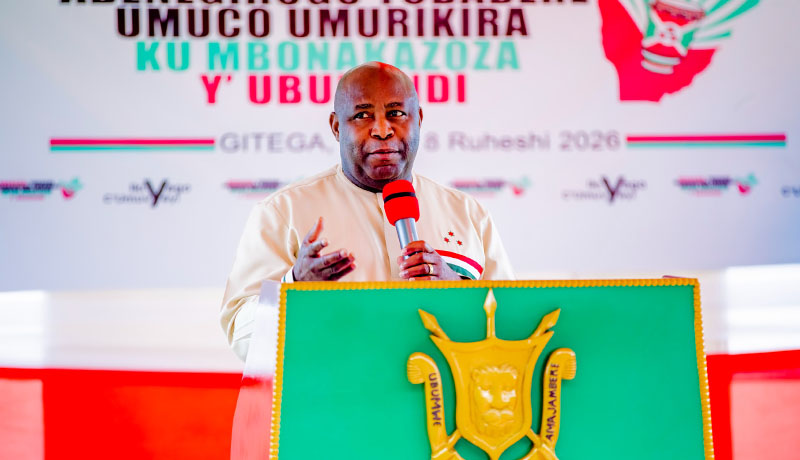
Burundian President Evariste Ndayishimiye criticized the lack of civism and patriotism among some high-ranking state officials during a moralization session held in Gitega on Monday, June 8. The President linked Burundi's development to an urgent return to values of foresight, integrity, and dedication to the homeland. The session took place at the Ingoma stadium in Gitega, following a wreath-laying ceremony at the mausoleum of President Pierre Nkurunziza. The moralization session served as a platform for President Ndayishimiye to address what he perceives as fundamental issues hindering national progress and unity.
President Ndayishimiye stated, "Ses actions doivent constamment viser l’amélioration du bien commun et l’inclusion, plutôt que l’exclusion ou le repli identitaire." This statement showed his belief that the actions of public servants must always be directed towards the collective good and promote inclusivity across the nation. He emphasized the inherent nature of patriotism, asking, "Avez-vous déjà vu quelqu’un apprendre à un poisson de nager ou un oiseau à voler? C’est dans leur nature et chaque Burundais devait être patriote comme nos ancêtres qui ont combattu l’envahisseur ensemble sans quelqu’un pour les galvaniser mais par amour pour leur mère patrie." Ndayishimiye attributed the current deficit in civism to early influences, noting, "Ce déficit de civisme prend sa source dès le plus jeune âge." He also noted a severe deficiency in guidance for the youth. "la jeunesse burundaise souffre aujourd’hui d’un manque criant d’encadrement et de transmission des valeurs nationales," Ndayishimiye said. He concluded that this fracture led to diluted patriotism, stating, "C’est à partir de cette fracture que le patriotisme s’est dilué, ouvrant la voie à la destruction nationale par manque d’amour pour la patrie." The President's remarks painted a stark picture of the challenges facing Burundi in fostering a strong national identity and collective purpose.
Officials' Misplaced Priorities
President Evariste Ndayishimiye observed that many officials appointed to roles of responsibility appear to believe their selection was for personal comfort and self-service rather than for national duty. He indicated that such individuals prioritize their own interests over the welfare of the Burundian populace. This self-serving attitude, he suggested, directly undermines the principles of good governance and public trust.
The President expressed his surprise that high-ranking officials required reminders about patriotism, a value he believes should be inherent in every citizen. According to Ndayishimiye, true patriotism should manifest naturally, without the need for external encouragement or instruction among those tasked with public service. He stressed that those entrusted with leadership positions should intrinsically understand their obligation to the nation.
Ndayishimiye also lamented that the educated elite are frequently among the first to exhibit signs of moral and patriotic weakness. He suggested that despite their advanced training and positions, these individuals often deviate from their national responsibilities. He questioned why those who have benefited most from the nation's educational system would be the quickest to abandon its core values. This observation pointed to a deeper societal issue beyond mere oversight.
The Burundian leader identified corruption as a direct consequence of this declining patriotism. He stated that those who monetize public services and engage in corrupt practices have effectively "sold their patriotism," thereby betraying the trust placed in them by the nation. This betrayal, he argued, not only erodes public funds but also damages the very fabric of national unity and development. He emphasized that such actions demonstrate a profound lack of dedication to the homeland and its people.
Defining True Leadership and Patriotism
President Evariste Ndayishimiye defined true leadership as requiring foresight and the capacity to inspire, motivate, and guide collaborators toward a shared objective. He elaborated that such leadership is key for national progress and collective achievement. He emphasized that a leader's role extends beyond mere administration, encompassing the vital task of uniting people behind a common vision.
According to President Ndayishimiye, a true leader must also embody patriotism, demonstrating a profound attachment to their homeland. This attachment, he stated, should translate into an unwavering dedication to serve the nation. He emphasized that this commitment is fundamental for anyone holding a position of responsibility within the government, asserting that without it, leadership lacks genuine purpose. He further stated that a true leader is a patriot, deeply attached to their homeland, ready to serve with unwavering dedication, setting an example for all citizens.
The Burundian President called for absolute integrity and patriotic action from officials, stating these qualities are essential for the reconstruction of a united Burundi. He stressed that without these foundational principles, efforts toward national unity and development would be undermined. Ndayishimiye's remarks showed his belief that personal values directly impact national trajectory. He reiterated that public servants must prioritize communal welfare over individual gain to effectively contribute to the country's future. He envisioned a nation where every official acts with the highest ethical standards, driven by a genuine love for Burundi.
Roots of Disconnect and External Threats
President Evariste Ndayishimiye invoked the memory of his predecessor, President Pierre Nkurunziza, presenting him as an example of how to genuinely love and serve the country. Ndayishimiye attributed the current deficit in civism and patriotism primarily to a lack of guidance and insufficient transmission of national values to the youth of Burundi. He indicated that this foundational gap contributes significantly to the observed decline in national sentiment among citizens, leaving them vulnerable to external influences.
Ndayishimiye also addressed historical influences, stating that the strategy of 'divide and rule' was originally introduced by colonizers with the specific aim of subjugating the Burundian people. He contended that this tactic created fissures within the society, undermining unity from an early stage and leaving a lasting legacy of division. The President further declared that "modern colonizers still exist" and actively work to prevent Burundians from loving their country. He asserted that a strong sense of national unity among Burundians would impede these external actors' objectives of "destruction and plunder," suggesting an ongoing struggle against external manipulation. He urged Burundians to recognize these threats and unite against them, emphasizing that national cohesion is their strongest defense. The President's address served as a powerful call to action, urging both officials and citizens to embrace a renewed sense of patriotism and collective responsibility for the future of Burundi.