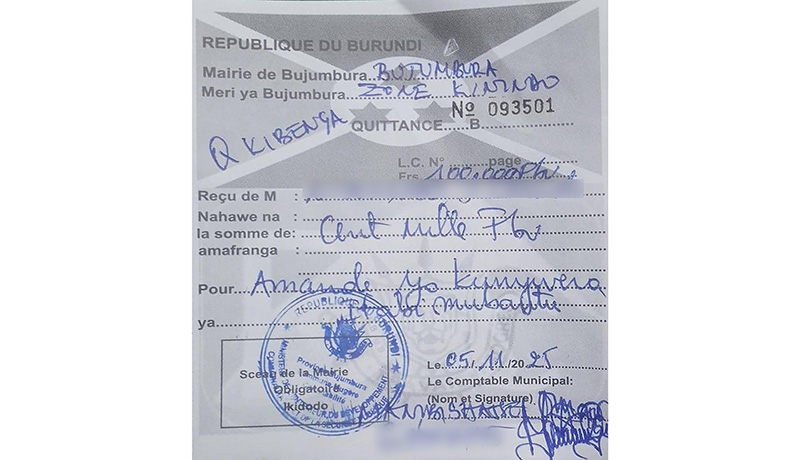
Residents of Bujumbura are currently expressing widespread discontent over what they describe as excessive and unexplained administrative fines. These penalties are frequently imposed by individuals whose identities or official attributions remain unclear, according to residents in areas such as Kamenge, Gihosha, Kanyosha, Mugere, Mukaza, and Ntahangwa. Residents of Bujumbura are lamenting these excessive administrative fines, particularly given the often-unknown identity or official attributions of those imposing them. Concerns are also mounting because these fines are reportedly collected without the issuance of official receipts, raising significant questions about transparency and accountability within the Ville de Bujumbura administration.
Disparities in Fines Emerge
Residents in Bujumbura are questioning inconsistencies in the application of sanctions, with some claiming to have incurred considerably higher fines than others for similar infractions. These disparities in the application of sanctions are a significant point of contention among the populace. J.N. A resident of Kamenge, reported paying a fine of 100,000 BIF after opening his shop before the scheduled conclusion of community development work on a Saturday. This specific instance notes the substantial financial burden placed on some individuals. However, O.G. A shopkeeper and acquaintance of J.N. From the same locality, was assessed a fine of 20,000 BIF for the identical violation. These examples illustrate the notable differing penalties imposed for the same type of administrative breach, leading to public outcry. The discrepancies have prompted calls for greater clarity regarding the criteria used to determine fine amounts across the Ville de Bujumbura. The differing financial burdens for what appear to be identical infractions have contributed significantly to the general public dissatisfaction and sense of injustice.
Unidentified Officials Impose Fines
Residents of Kanyosha have reported confusion regarding the identity of individuals imposing administrative fines, adding to the general uncertainty. A resident from the area stated that fines are sometimes demanded by police officers, while at other times, individuals in civilian clothing issue penalties. This situation leaves residents uncertain about the authority of those sanctioning them, according to the Kanyosha resident, and fuels concerns about the legitimacy of such enforcement. The lack of clear identification among fine collectors contributes to the broader concerns expressed by citizens in Bujumbura regarding transparency and the proper exercise of authority.
The practice of unidentified individuals imposing fines has been observed elsewhere in the city, further eroding public trust. A resident of Gihosha, who requested anonymity, described being fined by a person in civilian clothes. The penalty was issued because the resident's shop did not have a water bucket placed in front of it, an administrative requirement aimed at promoting cleanliness. This incident illustrates the imposition of fines by individuals not in official uniform, mirroring the Kanyosha resident's concerns about the legitimacy of such penalties and the lack of clear official attribution.
Legal Framework for Fines
Burundi's legal framework for administrative penalties is outlined in Article 643 of law n°1/27, enacted on December 29, 2017. This revised Penal Code stipulates that only regulatory acts and administrative or police regulations issued by public authorities and local powers are permitted to establish administrative fines. The law sets specific monetary limits for these fines, depending on the issuing authority, aiming to provide a clear structure for penalties. Administrative fines are capped at 50,000 BIF when established by decree, 20,000 BIF when set by ordinance, and 5,000 BIF when imposed by local authorities. This legal provision is intended to prevent arbitrary and excessive penalties. The legislation includes exceptions to these general limits, acknowledging specific areas where higher penalties may be necessary. These exceptions apply to administrative fines related to fiscal and customs infractions, as well as penalties concerning exchange regulations or economic matters, which may exceed the stated maximums due to their specialized nature.
Official Response and Sensitization
Official statements indicate that only authorized communal agents are permitted to impose administrative fines, a point often contradicted by residents' experiences. Adélaïde Hatangayo, the administrator of the Mugere commune, stated that residents have received adequate sensitization regarding regulations concerning fines. Hatangayo specified that this sensitization particularly focused on rules related to cleanliness and sanitation within the commune, implying that residents should be aware of their obligations and the potential penalties.