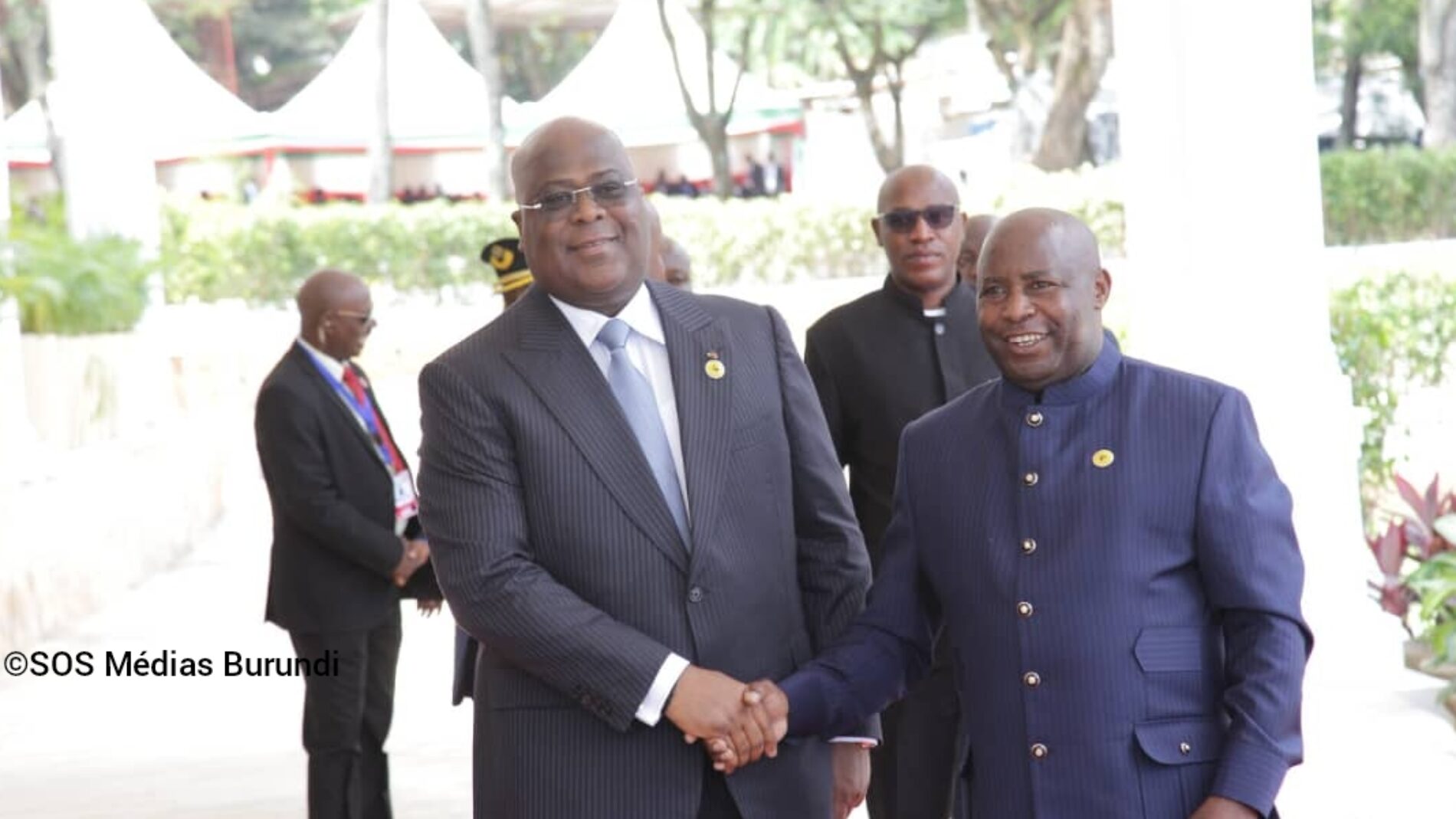
Presidents Félix Tshisekedi of the Democratic Republic of Congo and Évariste Ndayishimiye of Burundi met in Kinshasa on June 22, 2026, to assess and address the deteriorating security situation in South Kivu. The high-level meeting showed the urgent need for coordinated action in a region plagued by persistent instability and violence. The leaders focused on the territories of Fizi and Uvira, strategic areas within South Kivu that have been particularly affected by the ongoing conflict, aiming to deepen military cooperation between their nations. Their discussions specifically consolidated joint efforts in the Minembwe highlands, an area that has experienced intense fighting for several months, becoming a critical flashpoint in the regional conflict. This renewed military collaboration comes as thousands of civilians have fled their homes since February 2026, driven by the escalating conflict in the region, noting the severe humanitarian impact of the violence. The displacement crisis further amplifies the urgency of the security measures being discussed by the two heads of state.
Joint Military Strategy Review
The two presidents reviewed military operations that have been conducted against armed groups in the region since February 2026. This full review aimed to evaluate the effectiveness of current strategies and identify areas for improvement in confronting the various non-state actors operating in eastern DRC. Following their assessment, they decided to reinforce deployed troops, signaling a significant escalation of their joint military presence. They committed to improving operational capabilities through measures such as acquiring advanced drones, which are expected to enhance surveillance and precision strike capabilities against rebel strongholds. The leaders also agreed to revise existing intelligence systems to ensure more timely and accurate information sharing, key for effective counter-insurgency operations. A key strategic objective under consideration is a plan to neutralize strategic infrastructure, including the Minembwe aerodrome, which is believed to be used by armed groups. This measure is intended to restrict air movements within the combat zone, thereby limiting the logistical and operational capacity of these groups.
Burundi and the Democratic Republic of Congo are linked by a bilateral agreement that forms the legal basis for their military cooperation. This agreement explicitly authorizes the Burundian National Defence Force (FDNB) to deploy troops within the eastern DRC, providing a framework for cross-border operations against common security threats. This arrangement reflects a shared understanding of the interconnected nature of regional security challenges. Between August 2022 and December 2025, a substantial number of Burundian soldiers, over 29,000, were deployed in North Kivu and South Kivu provinces under this arrangement, demonstrating the scale of their commitment. The continued military collaboration reflects the ongoing commitment to address the security challenges in the volatile eastern territories, which have long been a sanctuary for numerous armed groups. The deployment of such a significant force shows the gravity of the situation and the determination of both nations to stabilize the region.
Ground Realities and Rebel Advances
The security situation on the ground remains highly volatile, marked by significant territorial gains by armed groups. The armed movement Twirwaneho, an ally of the M23, recently announced its control over the localities of Kakenge, Ilundu, Bidegu, and Kitavi. These advances represent a critical shift in control within the conflict zones and indicate the growing strength and coordination of rebel forces. These territorial gains followed violent clashes against the Armed Forces of the Democratic Republic of Congo (FARDC) and their allies in the region, noting the intense and often brutal nature of the fighting. The conflict has not only resulted in displacement and loss of life but also in significant infrastructure damage, with reports indicating that the Ilundu school and the Minembwe general hospital have sustained bombardments. Such attacks on civilian infrastructure exacerbate the humanitarian crisis and show the indiscriminate nature of the violence.
The M23 is an former Tutsi-dominated rebellion that resumed arms in late 2021, marking a resurgence of a group that had previously been largely dormant. The movement is currently integrated into the Alliance Fleuve Congo (AFC), a broader coalition led by Corneille Nangaa, a former head of the DRC's electoral commission. The integration of M23 into the AFC signifies a consolidation of various armed factions, posing an even greater threat to regional stability. The AFC/M23 now controls large portions of North Kivu and South Kivu provinces, demonstrating its extensive reach and operational capabilities. This includes strategic cities such as Goma and Bukavu, which are vital economic and administrative centers, further solidifying the rebels' control over key areas and their ability to disrupt governance and trade.
Regional Tensions and Historical Context
The escalating conflict is deeply intertwined with complex regional tensions and historical grievances. Kinshasa frequently accuses Kigali of providing support to the M23 rebel movement, an assertion that Rwanda consistently denies. These accusations are a persistent source of friction between the two neighboring states, complicating efforts for a unified regional response. In response, Kigali has accused the Democratic Republic of Congo and Burundi of collaborating with the Forces démocratiques de libération du Rwanda (FDLR), a group it alleges poses a security threat to Rwanda. The FDLR is primarily composed of Hutu elements, some of whom are implicated in the 1994 Rwandan genocide, making any alleged collaboration with them a highly sensitive issue for Rwanda. These reciprocal accusations show the deep-seated mistrust and complex dynamics between the nations involved in the escalating conflict, creating a cycle of blame and counter-blame that hinders diplomatic solutions.
The regional tensions are further exacerbated by the protracted nature of the conflict in eastern DRC, which has now lasted for nearly three decades. This enduring instability has created a complex web of alliances and antagonisms, with various armed groups operating across porous borders, often exploiting local grievances and resource wealth. The ongoing accusations and denials between Kinshasa and Kigali highlight the difficulty in achieving a lasting peace, as each side views the other's actions through a lens of historical grievances and perceived threats, making genuine reconciliation challenging. The involvement of multiple state and non-state actors, each with their own agendas and external allegiances, contributes significantly to the region's volatility, making full solutions challenging to implement amidst the prevailing mistrust. The long-standing conflict continues to displace populations, destabilize governance, and impede development in the eastern territories, perpetuating a cycle of violence and suffering for millions of people.