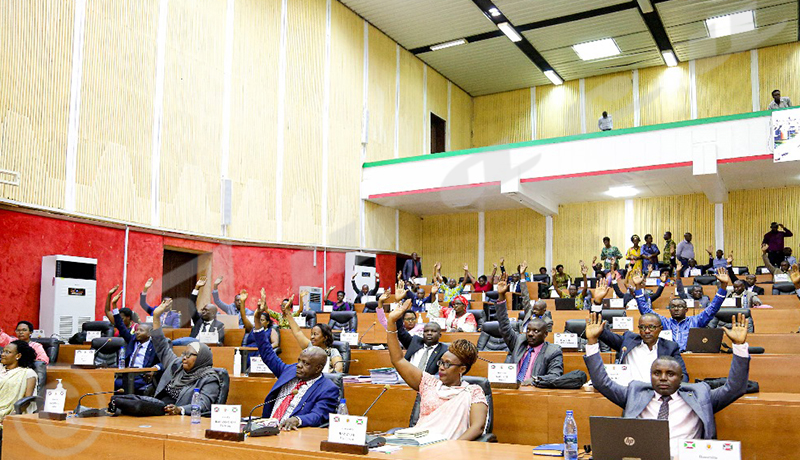
The President of the Republic promulgated Burundi's general budget for the 2026-2027 fiscal year on June 30, 2026, outlining significant government spending plans and a substantial deficit. The Burundian government intends to spend over 7,000 billion BIF during the upcoming fiscal year. This budget projects a considerable deficit, totaling 384,860,209,226 BIF when grants are included. Without grants, the deficit expands significantly to 2,260,691,169,819 BIF, indicating a substantial gap between planned expenditures and domestic revenues. The promulgation sets the financial framework for the nation's operations over the next year.
Budget Allocations and Spending
The ministry responsible for the budget received the largest allocation within the 2026-2027 general budget, with its share exceeding 3,000 billion BIF. These funds are designated for the ministry's operational and strategic financial management tasks. In contrast, the ministry in charge of youth was allocated 24 billion BIF for the upcoming fiscal year.
Budgets for the education, health, and environment ministries show increases compared to their allocations over the last three fiscal years, reflecting a shift in government spending priorities. The environment ministry's budget, in particular, rose to over 622 billion BIF for the 2026-2027 fiscal year. This marks a significant increase from approximately 334-335 billion BIF allocated in the preceding two years (2024-2025 and 2025-2026) and over 506 billion BIF in 2023/2024.
The health ministry's budget for 2026-2027 stands at over 315 billion BIF. This compares to nearly 195 billion BIF in the previous fiscal exercise (2025-2026), but is lower than the over 337 billion BIF allocated in 2023/2024. Meanwhile, the education ministry's budget increased from over 693 billion BIF in 2025-2026 to over 764 billion BIF in 2026-2027, indicating a consistent rise in funding for the sector.
Operating expenses constitute a substantial portion of the overall budget, representing about 48% of the total planned expenditure. This allocation for operational costs covers day-to-day government functioning and administrative requirements across ministries. The detailed allocations indicate the government's priorities for the fiscal year, balancing administrative needs with sectoral investments in key areas like education, health, and environmental protection.
Economic Challenges and Risks
Burundi faces significant economic challenges as it prepares for the 2026-2027 fiscal year, with fiscal pressure estimated between 16% and 19%. This level is considered insufficient for adequately funding public services and investments, yet it is also deemed high given the current state of Burundi's economy. The nation's internal debt is estimated at a substantial 6,300 billion BIF, contributing to concerns about the budget's long-term sustainability. Further indicating fiscal strain, credits allocated for fundamental and post-fundamental development have seen a steady decline, decreasing from 12% in 2024/2025 to 9% in 2025/2026, and further to 5% in the current 2026-2027 budget.
Prof Michel Masabo observed that revenue forecasts for the new budget increased by approximately 25.5%, while expenditure forecasts rose by 29% compared to the previous budget. Prof Masabo stated, "The new budget will not produce the expected result." He elaborated on his concerns, noting the increase in both revenue and expenditure forecasts. "Firstly, compared to the previous budget, revenue forecasts increased by around 25.5% while expenditure forecasts increased by 29%," Prof Masabo said. He also noted the persistent issue of operational expenses, stating, "Secondly, operating expenses remain significant. We can estimate them at around 48%." Prof Masabo further pointed to the substantial deficit, explaining, "Thirdly, it shows a very significant deficit. The overall deficit with grants is 384,860,209,226 BIF, while the overall deficit without grants is 2,260,691,169,819 BIF." Despite these figures, he acknowledged the government's ambition: "Fourthly, it is an ambitious budget that is oriented towards investment financed by domestic resources and it is estimated that this will help revive the economy."
Prof Masabo warned about the potential negative impacts of high fiscal pressure. "They are harmful," he asserted, explaining, "Firstly, fiscal pressure can reduce consumption, which slows down the economy. Households consume, and so do businesses. If taxes, and most are indirect taxes, are incorporated into prices, households will not consume enough, and businesses likewise." He continued, "Secondly, fiscal pressure reduces investment. When one does business, it is to make legitimate profits. And when the burden of taxes is very high, there are too many taxes. One risks being discouraged and stops investing." Prof Masabo also pointed out the risk of tax avoidance: "Thirdly, when taxes are too heavy, taxpayers risk adopting tax avoidance behaviors. They will seek, legitimately or illegitimately, to evade tax." He concluded his assessment by stating, "In short, the expected effect will not occur."
Prof Masabo outlined several challenges facing the budget. "Firstly, there is uncertainty regarding resource mobilization," he stated, adding, "It must not be forgotten that the revenue forecasts included in the budget are only estimates. We can reach them, if we exceed them it's better, just as we can fall short." He particularly questioned reliance on external aid: "Look at the amount inscribed for grants; it is very high compared to last year's budget. What justifies that we will have this? It is counting on external sources with uncertainties. We probably won't have it. External partners are not rushing to support the budget." Prof Masabo also noted the issue of inflation, stating, "Secondly, inflation is very high. It should not reach double digits. When inflation reaches 10%, it's already too much. In Burundi, we are at around 40%." He explained the consequences of high inflation: "We can cite reduced consumption and lack of competitiveness. Our products will not be competitive abroad. There will be general economic uncertainty. You place your capital, you are not sure of having interest and at what rate because inflation affects all of that." Finally, Prof Masabo identified the public debt as a significant hurdle. "The last challenge is the burden of public debt," he said, elaborating, "The figures we have been able to collect show that the internal debt is estimated at 6,300 billion BIF and external debt is around 1,900 billion BIF. We risk dedicating the bulk of resources to repaying this public debt." To address these issues, Prof Masabo suggested, "First, realistic objectives must be set in relation to the economic situation. For example, forecasts should not be overestimated when they are uncertain. One should not count on grants; they may or may not come." He also stressed the importance of rigorous resource mobilization, reducing non-essential expenditures, and consolidating the economy by combating inflation and prioritizing productive investments.
Expert Recommendations and Outlook
Burundi's inflation currently stands at approximately 40%, contributing to economic uncertainty as the country finalizes its 2026-2027 budget. The nation's external debt is estimated at 1,900 billion BIF, adding to the fiscal burden. Diomède Ninteretse, an economic analyst, estimates that Burundians' purchasing power may decrease by 40% during the 2026/2027 fiscal year. Ninteretse stated, "Taxes and duties will directly affect households and businesses that will want to bear the costs of a government that wants to live in the most prestigious way possible." He further described the budget approach as a strategic misstep, remarking, "In this situation where economic growth is projected at 4% with a budget increased by 40%, it is a strategic error that Burundi had not known since the dawn of time."
Pamphile Malayika, another economic analyst, recommended specific measures for fiscal management. Malayika suggested reducing expenses allocated to both domestic and international missions, as well as decreasing the upkeep costs for high dignitaries. "It is necessary to reduce the expenses allocated to missions, both internal and external, and to reduce the costs of the upkeep of high dignitaries," Malayika said. He also advised recovering and repatriating embezzled funds, noting that 7 billion BIF remain outstanding. Prof Michel Masabo, a financial expert, recommended setting realistic budget objectives relative to the economic situation. Prof Masabo emphasized the need for rigorous resource mobilization and consolidating the economy by actively working to reduce inflation. He also stressed the importance of prioritizing productive investments to stimulate economic growth.