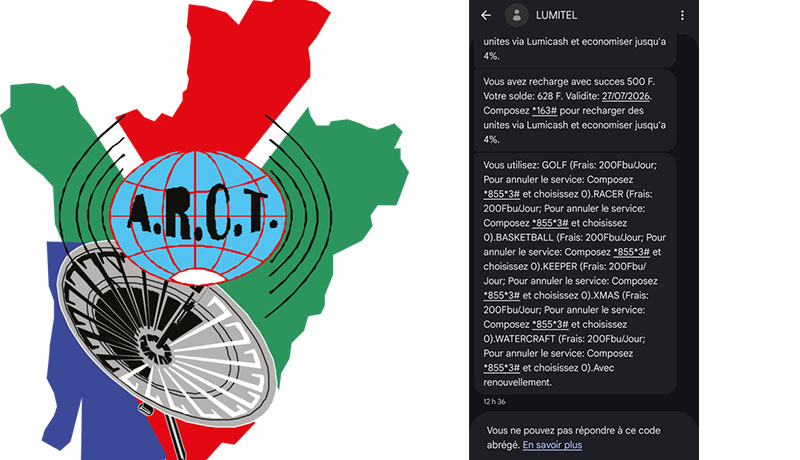
Lumitel subscribers have accused the telecommunications company of imposing daily, unauthorized deductions for "services à valeur ajoutée" (value-added services), prompting widespread calls for immediate reimbursement. These accusations highlight a significant and growing concern among mobile users in Burundi. Consumers are demanding the cessation of these recurring charges and the return of all sums already deducted from their accounts, emphasizing the urgent need for a resolution. The allegations point to a pattern of charges impacting daily balances, with customers reporting significant losses that have eroded their trust in the service provider.
A young woman customer, speaking about her experience, stated that she loses approximately 200 BIF per day due to these deductions. This daily depletion of funds has fueled consumer frustration across Lumitel's subscriber base in Burundi, leading to widespread discontent. The collective demand from subscribers emphasizes not only the halt of future deductions but also a full financial restitution for past charges. This situation has brought to the forefront critical concerns over transparency in billing practices for mobile services, particularly regarding the activation and ongoing charges for value-added services. Subscribers are increasingly vocal about the need for clearer communication and explicit consent mechanisms for any service that incurs a cost.
Subscriber Outcry and Financial Impact
Subscribers of Lumitel have reported daily deductions that vary significantly, ranging between 100 and 480 BIF, contributing to a widespread financial impact on their accounts. These fluctuating amounts, though seemingly small on a daily basis, accumulate quickly, causing considerable distress. Félix, a Lumitel subscriber, stated that his account consistently experiences a daily deduction of 120 BIF, a sum that, over time, represents a substantial portion of his mobile credit. These recurring charges have led to unexpected depletion of mobile credit for numerous users, often leaving them without sufficient funds for essential communication.
One user detailed an instance where their credit vanished shortly after recharging, resulting in an insufficient balance to make calls, noting the immediate and disruptive consequences of these deductions. Such incidents show the direct financial strain on subscribers, affecting their ability to utilize basic mobile services, which are often key for daily life and business. Jean Ndenzako, a concerned individual and economist, estimated the cumulative financial burden of these daily deductions on households. Ndenzako calculated that a consistent daily deduction of 120 BIF translates to approximately 3,600 BIF per month for each affected household. This monthly sum represents a significant unforeseen expense for subscribers who rely on their mobile credit for communication, especially in an economy where every franc counts. The economist further elaborated that for many families, this unexpected expenditure can disrupt household budgets and limit access to vital communication channels.
The widespread nature of these complaints suggests a systemic issue rather than isolated incidents. Subscribers are reporting similar patterns of deductions, often without clear explanations or prior consent for the services being charged. This lack of transparency has exacerbated consumer frustration and fueled calls for immediate intervention from regulatory bodies. The financial implications extend beyond mere inconvenience, impacting the ability of individuals to stay connected, which is increasingly essential in modern society.
Consumer Association and Regulatory Response
Complaints regarding unauthorized daily deductions have persisted since November 2025, indicating a long-standing issue that has yet to be fully resolved. Pierre Nduwayo, president of the Burundian Consumers Association (Abuco), stated that the organization has been aware of this situation for several months, having received a steady stream of grievances. Abuco began receiving numerous complaints from mobile users in 2025, primarily from Lumitel subscribers, concerning these recurring charges for "services à valeur ajoutée." The sheer volume of complaints received by Abuco showed the scale of the problem and the urgent need for consumer protection.
According to Mr. Nduwayo, more than three-fifths of subscribers are affected by these "value-added services" deductions, indicating a widespread issue rather than isolated incidents. This high percentage suggests that a significant majority of Lumitel's customer base may be experiencing these unauthorized charges, raising serious questions about the company's billing practices and customer consent mechanisms. In response to the growing outcry, Abuco recommends that consumers use the code 8009# to check and deactivate these services, providing a practical, albeit reactive, solution for affected individuals to regain control over their mobile credit. This recommendation has become a key piece of advice for subscribers seeking to stop the daily deductions.
The regulatory body, ARCT (Telecommunications Regulation and Control Agency), conducted investigations with the operator Viettel, which operates as Lumitel in Burundi, to understand the root cause of these widespread complaints. Emmanuel Misago, an ARCT official, noted that these investigations indicate the problem primarily stems from "misuse of the terminal" rather than theft by operators. ARCT's findings suggest that subscribers often activate auto-renewing, paid value-added services (VAS) themselves, sometimes inadvertently, leading to the recurring charges. Misago’s explanation points to a potential gap in user awareness or understanding of how these services are activated and managed. He further advised that subscribers should exercise caution when interacting with promotional messages or applications that might lead to unintended subscriptions.
Despite ARCT's findings, consumer groups argue that the responsibility also lies with the operators to ensure clearer communication, explicit consent, and easy deactivation processes. The persistent nature of the complaints, even after regulatory investigations, notes the complexity of balancing user responsibility with operator transparency. The regulatory framework is now under scrutiny to ensure it adequately protects consumers from practices that, even if technically user-initiated, lead to significant financial detriment and widespread dissatisfaction.
Economic Analysis and Market Dominance
Jean Ndenzako, an economist, characterized the situation as an abuse of dominant position by Lumitel, noting the company covers 100% of the territory. This extensive coverage means that for a significant portion of the population, Lumitel is the only viable option for mobile communication, making it difficult for subscribers to switch providers even when dissatisfied. Ndenzako stated, "The incident involving Lumitel in Burundi goes beyond a simple commercial dispute to fall within the issue of market regulation in a dominant position situation." He further suggested that a daily deduction of 120 BIF can be considered a private "micro-tax" without prior notification. "With the mechanism of furtive deduction, a daily withdrawal of 120 BIF may seem negligible at the individual level. However, this sum acts as a private 'micro-tax'," Ndenzako explained, noting how small, recurring charges can amount to significant revenue for the operator without explicit consent from the consumer. He added that the situation illustrates a "failure of contractual transparency" and that the operator captures a rent without explicit service counterpart. This economic perspective frames the issue not merely as a billing error but as a structural problem arising from market power.
Emmanuel Misago, spokesperson for the Telecommunications Regulation and Control Agency (ARCT), confirmed the agency has been addressing this grievance, acknowledging the seriousness of the situation. Misago advised, "Subscribers should not activate any message sent to their phones," reinforcing the idea that user vigilance is a key factor in preventing these charges. However, Ndenzako noted that the mechanism of "voting with one's feet" (changing operators) is inoperable due to Lumitel's market dominance, stating, "This is an abuse of dominant position since Lumitel is the only recourse for a large part of the rural population." He acknowledged Lumitel as the most accessible network in many remote regions of the country, making it an indispensable service for a vast segment of the Burundian population. This lack of viable alternatives severely limits consumer choice and bargaining power, effectively trapping subscribers in a system where they must endure these deductions or lose essential connectivity.
The company Viettel, operating as Lumitel, offers subscribers over 60 paid value-added services via mobile phones, a vast array that can be confusing for users to navigate and understand. Ndenzako suggested that if funds generated from these deductions are converted to foreign currency and repatriated by the parent company (Viettel), it increases pressure on the country's limited foreign exchange reserves. This economic drain adds another layer of concern, moving the issue beyond individual consumer complaints to a matter of national economic impact. He warned, "Without strong regulation, Lumitel's competitive advantage, particularly its national coverage, risks becoming a tool for economic extraction rather than a driver of development." Ndenzako further commented that the persistence of these complaints since November 2025 "shows the urgency of an intervention by the Telecommunications Regulation and Control Agency (ARCT)," emphasizing that the problem has been ongoing for a considerable period without a definitive resolution. The economist's analysis paints a picture of a market imbalance where the dominant player can impose charges that, while individually small, collectively represent a significant transfer of wealth from consumers to the operator, potentially impacting the national economy.
Calls for Action and Future Implications
The Telecommunications Regulation and Control Agency (ARCT) has taken steps to address the issue, instructing all operators, including Viettel, which operates as Lumitel, to notify subscribers via SMS for each service subscription and renewal, detailing corresponding fees. This measure aims to enhance transparency and ensure that consumers are fully aware of any charges they incur. However, the effectiveness of this directive in practice remains to be seen, especially given the ongoing nature of the complaints.
Economist Jean Ndenzako warned that the current practices could lead to physical hoarding of money, as individuals lose trust in digital transactions and prefer to keep their funds in physical cash. This shift could have broader implications for financial inclusion and the development of a digital economy. He also cautioned that such practices foster technological mistrust, thereby slowing the adoption of digital services, which are key for economic modernization and efficiency. The lack of trust in mobile money systems, fueled by unauthorized deductions, could hinder progress in areas like mobile banking and e-commerce.
Ndenzako called for strong intervention from ARCT, advocating for an independent technical audit of Lumitel's billing systems to thoroughly investigate the mechanisms behind these deductions and ensure compliance with regulatory standards. He also demanded full reimbursement of sums collected without explicit opt-in consent, emphasizing that consumers should not bear the cost of services they did not knowingly agree to. Ndenzako pushed for strengthened sanctions for transparency violations, arguing that current penalties may not be sufficient to deter operators from engaging in such practices. These proposed actions aim to restore consumer confidence, ensure fair market practices, and protect the integrity of the telecommunications sector in Burundi. The long-term implications of unresolved issues like these could be significant, impacting not only individual consumers but also the broader digital transformation efforts within the country.