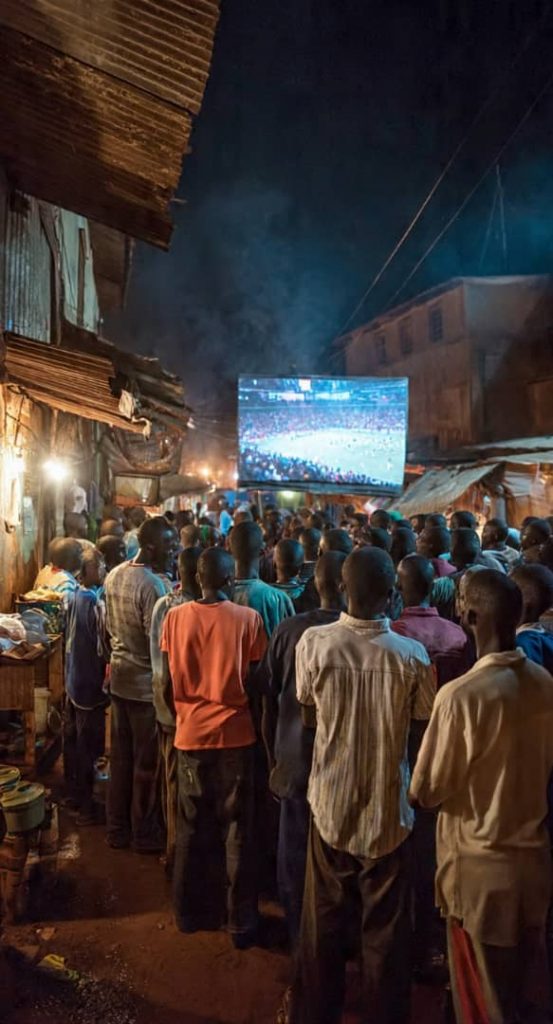
Residents in Buyenzi, Burundi, reacted to football match outcomes on Sunday, June 28, and Tuesday, June 30, as international fixtures captivated the neighborhood. The dates marked significant moments in the community's engagement with global football, transforming ordinary days into eagerly anticipated events. On June 28, a match saw Morocco draw 1-1 against the Netherlands, a result that resonated deeply among local fans, sparking immediate discussions and analyses of the game's unfolding drama. The draw set the stage for further suspense, keeping the community on edge. Two days later, on June 30, the Ivory Coast suffered a 2-1 defeat to Norway, a result that further shaped the local sentiment around the sport and brought a mix of disappointment and renewed determination to support other African teams. These games provided focal points for community engagement and discussion within Buyenzi, reflecting the broader impact of African football on daily life. The outcomes of these matches contributed significantly to the daily pulse of the neighborhood, illustrating how international sports can profoundly influence local moods and interactions. The shared experience of watching and reacting to these games fostered a sense of collective identity and passion among Buyenzi's inhabitants, turning each match into a communal event.
Scenes of Shared Passion
The football fervor continued to grip Buyenzi, Burundi, with residents reacting with palpable intensity to further international match outcomes. The atmosphere in the neighborhood was a dynamic blend of anticipation, excitement, and sometimes, profound disappointment. South Africa experienced a 0-1 loss to Canada, a result that dampened spirits among some fans who had held high hopes for the team. The defeat was met with groans and sighs in various viewing spots across Buyenzi. Maman Claudine, a local resident known for her candid commentary, expressed her disappointment vividly, stating, "Aya…" her voice trailing off in a mixture of disbelief and sorrow. She later added a poignant and culturally resonant observation, "The Canadians, with their cold, they froze our hearts," encapsulating the feeling of a promising effort being thwarted. This sentiment was echoed by many, as the community processed the unexpected setback for the South African team.
However, the mood in Buyenzi was not solely defined by losses. Celebrations erupted with unbridled joy when Morocco secured a triumphant victory against the Netherlands in a penalty shootout. This win, particularly after the earlier 1-1 draw, provided a moment of immense pride and triumph for supporters, transforming the streets into scenes of spontaneous jubilation. The air was filled with cheers, ululations, and the rhythmic beat of makeshift drums as residents celebrated the resilience and skill of the Moroccan team. This victory served as a powerful counterpoint to the earlier disappointment, reaffirming the community's belief in African football prowess. Amidst these emotional reactions to past games, residents also eagerly engaged in discussions about upcoming fixtures, offering various estimations on team performances based on their knowledge, intuition, and fervent hopes. A student, demonstrating a thoughtful approach to sports analysis, assessed the RDC's chances against England at 40%, reflecting a cautious optimism tempered by an awareness of the formidable opposition. Maman Claudine, ever vocal and passionate, also weighed in on another anticipated match, predicting a 60% probability for Egypt against Australia. She emphasized her confidence by uttering the revered name, "Mo Salah," which was met with nods of agreement and understanding from onlookers, acknowledging the star player's immense talent and influence. Her conviction was further solidified with a declaration that resonated deeply with the community's pride: "A pharaoh does not bow before kangaroos." Similarly, a young person in the neighborhood, representing the aspirations of the younger generation, estimated Cape Verde's chances against Argentina at 30%, noting the diverse range of expectations and hopes within the community for various African teams. These discussions, whether analytical or passionate, formed the vibrant tapestry of daily life in Buyenzi.
Whispers of Hope and Fate
The intricate web of predictions and hopes continued to be woven throughout Buyenzi, with individuals from all walks of life contributing their insights. Fatou, a well-regarded hairdresser in Buyenzi, whose salon often served as a hub for local gossip and spirited debate, confidently predicted an 80% chance for Senegal against Belgium. Her assessment reflected not only her personal belief but also the community's growing engagement with the upcoming international football fixtures, where Senegal was seen as a strong contender. Fatou, with her finger on the pulse of neighborhood sentiment, also commented on a previous match with a touch of poignant realism. She stated unequivocally that the Ivory Coast's chances against Norway were 0% after their 2-1 loss, a result that had effectively eliminated them from the competition. Her words captured the collective despair felt after the defeat: "« C’est fini. On a poussé, mais le fjord a gagné 2-1. 0%. On rentre. Abidjan pleure ce soir. »" This statement, delivered with a mix of resignation and sorrow, showed the emotional investment residents had in the performance of African teams. It painted a vivid picture of the disappointment that rippled through the community, imagining the grief extending all the way to Abidjan.
Adding another voice to the chorus of predictions, a local taxi driver, whose daily routes connected him with countless residents and their opinions, offered his forecast for another key match. He gave Algeria a 55% probability against Switzerland, a prediction that likely stemmed from conversations with passengers and his own assessment of team strengths. His perspective, grounded in the everyday interactions of the neighborhood, provided another layer of insight into the community's collective foresight. Papi Serge, a prominent and respected voice in the neighborhood, known for his wisdom and passionate declarations, estimated Ghana's chances against Colombia at 45%. His confidence in the Ghanaian team was palpable, and he articulated it with characteristic flair, noting, "« Les Black Stars. Ils ont le rythme et la colère. 45%. La Colombie danse, mais nous, on tape. »" This quote not only noted his belief in Ghana's competitive spirit but also painted a vivid image of their playing style, contrasting it with that of their South American opponents. Papi Serge also fondly recalled Morocco's earlier victory over the Netherlands, celebrating it with an evocative phrase: "« Ils ont vaincu les moulins ! Les Hollandais avec leur football de géomètre… Les Marocains les ont noyés dans le cœur ! »" His words captured the essence of the Moroccan triumph, portraying it as a victory of heart and passion over methodical play, a narrative that resonated deeply within Buyenzi. It was noted that Tunisia had already been eliminated from the competition before these specific match predictions began circulating in Buyenzi, a fact that added a layer of realism to the community's hopes, acknowledging the harsh realities of international football.
The discussions in Buyenzi encompassed a wide and exciting range of upcoming matches, each carrying its own weight of anticipation and hope. These included the high-stakes encounter between Senegal versus Belgium, the challenging match-up of RDC against England, the strategic battle between Algeria versus Switzerland, the intriguing clash of Egypt versus Australia, the dynamic contest of Ghana against Colombia, and the underdog story of Cape Verde facing Argentina. The collective sentiment in Buyenzi, often described as its "reason," anticipated that four African teams would ultimately qualify for the next stage: Senegal, Morocco, Egypt, and Algeria. This prediction was based on a pragmatic assessment of team performance and perceived strengths. However, the neighborhood's "faith" extended this prediction, adding another layer of optimism and belief. This more hopeful outlook projected five qualified African teams, additionally including Ghana, a team that often captivated the community with its spirited play. A more optimistic and perhaps audacious outlook, affectionately termed Buyenzi's "folly," projected an even grander vision of seven qualified African teams, boldly incorporating RDC and Cape Verde into the hopeful roster. These varied predictions, ranging from reasoned analysis to fervent belief and audacious hope, noted the blend of analytical judgment and passionate, unwavering support among the residents of Buyenzi, showcasing the depth of their connection to African football.
Africa's Unyielding Spirit
The article concludes with a powerful and resonant statement: that Africa does not beg for its place but takes it. This assertion is not merely a declaration but is robustly supported by concrete examples from the recent matches, demonstrating the continent's growing prowess and determination on the global football stage. Morocco's victory on penalties, a moment of intense drama and skill, serves as a prime illustration of this spirit. The fact that this decisive win occurred at 3:00 AM local time in Buyenzi only amplified its significance, as dedicated fans stayed up into the early hours to witness and celebrate their team's hard-fought triumph. This late-night celebration showed the profound commitment and passion of the Buyenzi community, willing to sacrifice sleep for the glory of African football. The collective roar that erupted in the quiet pre-dawn hours was a testament to the unyielding spirit that permeates the neighborhood.
This spirit is further reflected in the community's varied predictions, which, despite their differences in optimism, all converge on a fundamental belief in African teams' capabilities. From the reasoned expectation of four qualifiers to the faithful hope for five, and the audacious folly of seven, each prediction embodies a refusal to accept anything less than what is deserved. The discussions, the passionate declarations, and the shared moments of joy and sorrow all contribute to a narrative where African teams are not just participants but contenders who command respect and achieve success through sheer will and talent. The vivid imagery used by residents like Papi Serge, describing Moroccan players "drowning" their opponents in heart, or Maman Claudine's assertion that a "pharaoh does not bow before kangaroos," are more than just commentary; they are expressions of a deep-seated pride and an unwavering conviction in African excellence. These sentiments, born from the heart of Buyenzi, resonate far beyond the neighborhood, echoing the broader continental aspiration for recognition and triumph in the world of sports. The victories, the valiant efforts, and even the disappointments serve to strengthen this resolve, cementing the belief that Africa is indeed taking its rightful place on the global stage, not through entreaty, but through performance and an indomitable spirit.