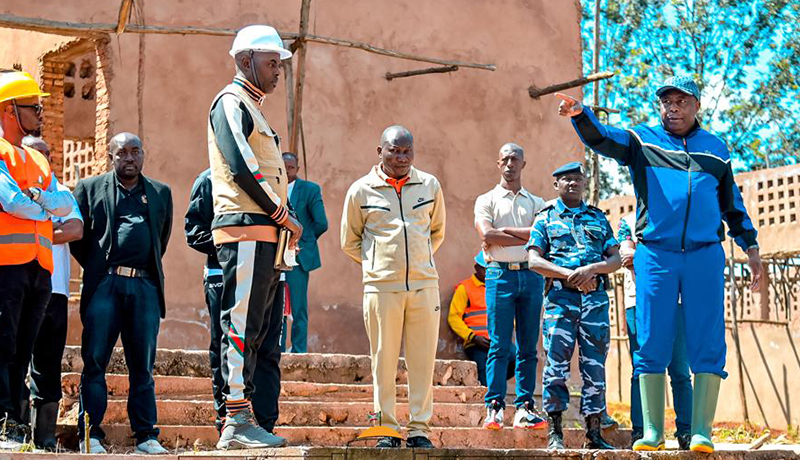
Burundian President Evariste Ndayishimiye on May 18, 2026, visited the Karusi rabbit breeding center in Gitega province, where he denounced corruption and promised an audit of the 2.391 billion BIF spent on the project since 2023. During his visit, President Ndayishimiye questioned the progress and expenditure, leading to the immediate dismissal of an OBUHA chief from the project. The President's visit to the Karusi rabbit breeding center in Gitega province on May 18, 2026, showed his commitment to scrutinizing public spending and project execution. He specifically promised an audit on the use of over 2.391 billion BIF that had been spent on the Karusi rabbit breeding center project since 2023, noting the significant financial investment under review.
The President expressed strong disapproval over the project's slow pace and perceived mismanagement of funds. "Quel est le budget déjà octroyé pour la construction de ces maisons? Au total, on vous a déjà donné combien?" President Ndayishimiye asked officials, according to local reports. He continued, "Est-ce que vous savez qu’avec ce montant, je peux construire deux centres du genre, même trois? Faut-il que je vous montrer le centre construit à Kibimba? Qu’est-ce que vous avez ajouté depuis ma dernière visite ici?" The President criticized what he saw as a lack of tangible progress despite significant investment. "J’ai vu que tu m’as mené en bateau ici et là, j’avais déjà fait une visite ici, montrez-moi ce qui a été fait après?" he stated. He then declared, "Silence! M. Le ministre, on leur retire de ce projet. L’OBUHA est disqualifié. Je ne veux même plus l’entendre dans ce projet. Je vais effectuer un audit, mes techniciens vont compter tout le budget utilisé dans ce projet. C’est incompréhensible." President Ndayishimiye added, "Quelle stupidité! Pensez-vous que les biens du pays sont à gaspiller? C’est une bévue de ne pas pouvoir montrer la phase I, la phase 2 et la phase 3! Allons voir le coût du centre naisseur de Cibitoke ou celui de Kibimba? Et tu viens me raconter des histoires? Tout ce que vous savez c’est manger seulement. Vous n’êtes capable de rien. Entendons-nous sur une chose: T’es disqualifié, je vais envoyer ceux qui vont mener un audit technique et financier. La suite, on la saura." He concluded by saying, "Vous n’êtes là que pour manger, être payés sans travailler. C’est intolérable. Cherchons nos techniciens pour le faire. Vous allez voir dans moins de 5 mois, ça sera fini."
President's Scathing Visit and Dismissal
During President Evariste Ndayishimiye's inspection, Dr. Ir Lieutenant-Colonel Léonidas Nibigira, General Commissioner of OBUHA, faced direct criticism from the President. Dr. Ir Lieutenant-Colonel Nibigira initially addressed the President, stating, "Je vous présente l’équipe de projet faite pour votre visite ici au Centre naisseurs de Karusi. A vos ordres Excellence président de la République…" The President subsequently rebuked the OBUHA chief for the lack of progress at the site. The public reprimand showed the President's frustration with the slow pace of development and the perceived misuse of public funds allocated to the project.
Dr. Ir Lieutenant-Colonel Léonidas Nibigira was dismissed from his role the day after President Ndayishimiye's visit and public reprimand. His dismissal followed the President's expressed dissatisfaction with the management of the Karusi rabbit breeding center project. The President had previously declared OBUHA disqualified from the project during his visit, effectively signaling the end of Dr. Ir Lieutenant-Colonel Léonidas Nibigira's tenure. The swift action taken by the presidency noted the seriousness with which the government views accountability in public works.
Another project managed by OBUHA, the construction of the Burundi Revenue Authority (OBR) headquarters, has also encountered significant delays. The OBR headquarters was initially planned to be twelve stories high but has stalled at the fifth level. This unfinished state contributes to broader concerns about OBUHA's project management capabilities and financial oversight, raising questions about the organization's ability to deliver on its commitments. The ongoing issues at multiple sites suggest systemic challenges within the agency.
Widespread Infrastructure Woes
Burundi's Minister of Finance, Alain Ndikumana, warned on May 13, 2026, that the nation risks becoming "a country of unfinished projects" if ongoing construction infrastructures are not completed. Ndikumana addressed the lower house of parliament that day, expressing concern over the stalled progress of various government initiatives. His warning noted a critical issue facing the nation's development agenda. Among these, the construction project for the Burundi Revenue Authority (OBR) headquarters, launched on December 17, 2020, by President Evariste Ndayishimiye with an estimated budget of 68 billion BIF, has been stalled for three years. This significant project, meant to house a key revenue-generating institution, remains incomplete despite substantial investment and presidential endorsement.
Another significant project facing delays is the new headquarters of the Bank of the Republic of Burundi (BRB), which has been under construction since 2019. This prolonged timeline further contributes to the Minister's stated concerns about project completion rates across the country, indicating a broader pattern of infrastructure challenges. Additionally, an international conference hall in Bujumbura, initiated by OBUHA in April 2022 with an initial 18-month deadline, remained non-operational as of May 2026. The failure to complete such a high-profile facility within its stipulated timeframe further exemplifies the difficulties plaguing public construction projects in Burundi. These delays not only represent financial losses but also hinder the country's economic and diplomatic potential.
The handover ceremony for the new OBUHA Commissioner took place on Wednesday, May 20, 2026, following the dismissal of the previous chief amid project mismanagement allegations. This transition shows the government's efforts to address the leadership and operational shortcomings within the organization. The Minister of Finance previously stated, "In the Ministry of Health, there will be no new hospitals or health centers built before the completion of those that are still under construction." This directive shows the government's push to prioritize finishing existing projects before embarking on new ones, signaling a shift in infrastructure development strategy to address the widespread delays and ensure more efficient use of public resources.
Concerns Over OBUHA's Capacity
Msc. Arch. Dieudonné Nkunzimana has been appointed as the new General Commissioner of OBUHA, following the recent dismissal of his predecessor. The appointment comes as scrutiny intensifies on the organization responsible for public buildings and housing projects in Burundi. OBUHA, whose full name is the Office Burundais de l'Urbanisme, de l'Habitat et de la Construction, was established by law n°1/079 on May 10, 2019, to oversee various state construction initiatives. This legal framework outlines its extensive mandate in urban planning, housing, and construction, making its operational effectiveness key for national development.
Concerns about the organization's capabilities have been voiced by civil society. Gabriel Rufyiri, president of the anti-corruption organization OLUCOME (Observatoire de Lutte contre la Corruption et les Malversations Économiques), stated that OBUHA's responsibilities may exceed its current resources. Rufyiri told reporters, "Ses missions dépassent largement ses capacités," indicating a potential mismatch between the scope of work and the available human and technical talent within the agency. This assessment from a prominent anti-corruption watchdog suggests that the problems extend beyond individual mismanagement to structural issues within OBUHA. Rufyiri's statement notes a critical observation that OBUHA's ambitious mandate, as outlined in its founding law, may be outstripping its practical ability to execute.
Rufyiri further elaborated on the perceived overextension of OBUHA's role, noting the breadth of its involvement in projects. He noted that the organization serves multiple functions simultaneously, stating, "L’OBUHA est à la fois maître d’œuvre, structure de surveillance, structure de réception et même chargée de l’achat des matériaux." This multifaceted role, according to Rufyiri, contributes to the challenges OBUHA faces in completing projects efficiently and transparently, as it creates potential conflicts of interest and strains limited resources. The criticisms emerge as several high-profile construction projects managed by OBUHA have faced significant delays and cost overruns, reinforcing the call for a reassessment of the organization's structure and operational model.